Face Grooving Innovation Like Only BIG KAISER Can

Multiprocess or multitasking machine tools Coated Inserts are typically thought of as machines combining operations such as milling, turning and perhaps grinding within a single machine tool. A more focused metalcutting operation that multitasking machines might also perform is gearcutting.

But when does gearcutting on a more versatile CNC machine make more sense than a conventional dedicated hobbing machine? I spoke with Mazak Senior Applications Engineer Mike Finn and Cybertec Hybrid Multi-Tasking Manager Joe Wilker to find out. We discussed the Mazak Integrex i-630V AG Hybrid multitasking machine, which is designed to cut gears through CNC milling and skiving.

Multitasking machines benefit from being able to perform multiple machining operations in a single setup. Here, we see an Integrex i-630AG using a skiving operation to cut teeth into the ID of a part. Photo Credit: Mazak

To Hob or Not To Hob

Although dedicated gear hobbing machines are the dominant production method for making metal gears, this process has faced competition in recent years from milling and skiving as customer demand has changed. Just-in-time and lean manufacturing philosophies have led many traditional gear customers to avoid keeping large backstocks, which has led to smaller order sizes across many industries.

While hobbing is the fastest method of gear manufacturing, its economic viability is questionable for shops with high-mix, low-volume work. According to Finn, the flexibility of a multitasking machine makes up for the difference in speed. “While specialty gear machines are best for high-volume gear applications producing tens of thousands of units of a single part, the trade-off is what happens to this specialty gear machine once the job is over,” he says. “Multitasking auto-gear machines like the i-630AG can be easily changed over to a new job or even a different process.”

The reason it is so easy to change to a new job with a CNC milling or multitasking machine is simple: While a hob must be designed with the final profile of the gear teeth in mind, a single end mill can cut numerous gear tooth geometries without needing changed. The economics of scale mean that high-mix, low-volume shops will get far more use out of their tooling using CNC end mills that can cut numerous features, while low-mix, high-volume shops will get more use out of a few hobs that can produce identical gears more quickly.

MIlling gears on a multitasking AG machine provides flexibility to the user. An end mill can be used to machine numerous features, which means they can be useful for complex parts with gear features, as well as low-volume work. Photo Credit: Mazak

Another draw to multitasking machines is their ability to fully machine parts with splines or gear teeth in a single chucking. Rather than using different machines for the gear features and the milling or turning processes, the user can produce a complete product in a single setup. This reduces the amount of time a shopfloor worker must spend loading and unloading machines, making them much more competitive in smaller batch sizes.

According to Finn, we also cannot discount the changeover between different processes. “A multitasking auto-gear machine has a quick changeover from gear skiving to gear hobbing to gear milling,” he says. “This enables users to more quickly produce complex gears with multiple features.”

Flexible Gearcutting in Five Axes

According to the company, the i-630AG is capable of five-axis machining and is designed to produce large, complex parts. Additionally, it can machine difficult materials such as hardened steel using cutting tools with a maximum diameter of 10.24 inches and max length of 19.69 inches. With large, complex gears being ideal for low-mix, high-volume work, it is well positioned for outcompeting dedicated hobbing machines in its niche.

There are other benefits specific to multitasking machines, according to Wilker. “Using a multitasking machine simplifies the programming, in comparison to using both a hobbing machine and a mill,” he says. Additionally, it enables in-process gear measurement, making it easier to avoid scrap. And according to Wilker, “Datum points can be held in relation to gear teeth with one chucking, improving part accuracy.”

Every machine shop must make its own economic calculations on how to make purchases. For some, the batch sizes of customers’ orders can justify investing in a dedicated hobbing machine. However, the flexibility of being able to skive the OD while milling complex features without changing machines will appeal to others. Photo Credit: Mazak

Both the C and B axes are monitored in the i-630AG using rotary-axis scale feedback, and both are synchronized to prevent fluctuations in the spindle speeds from producing out-of-spec parts. The machine uses Mazak’s Mazatrol SmoothAI control and includes Smooth Gear Cutting software, which automatically adjusts cutting parameters if either the milling or turning spindle drifts away from the target speed. “Thanks to the machine’s synchronization, we’ve increased productivity,” says Wilker. “Additionally, heat-treated materials can be cut with carbide cutters and cut small-to-large / heavy-ID or -OD gears based on machine models.”

According to the company, the machine’s control is designed to enable the user to completely program a job at the machine, rather than offline or at a dedicated CAM system. “This lets users create a part program in its entirety, including turning, drilling, milling and Threading Inserts gear-tooth machining on the machine control without additional software and without a part model.” For users nervous about programming entirely on the machine control, each gear-cutting module can be verified through toolpath simulation accessible on the control.

For a machine shop, it is dangerous to rely on old orthodoxy when it comes to growing the business, as we can see with this machine. While experience can guide shops well, it is important to dispassionately interrogate the way parts are processed and decide if that is still the way forward. Where once productivity and precision were the only measures of a machine’s value, it seems that more shops are performing this calculus and concluding that flexibility is vital to their success.

The Carbide Inserts Website: https://www.estoolcarbide.com/

How Industrial Prototyping for a Headlamp is Carried out

Why is tungsten carbide an ideal tool material?

Tungsten carbide is the most widely used type of high-speed machining (HSM) tool material produced by powder metallurgy, consisting of hard carbide (usually tungsten carbide WC) particles and a softer metal bond. composition. At present, there are hundreds of WC-based tungsten carbides with different compositions, most of which use cobalt (Co) as a binder. Nickel (Ni) and chromium (Cr) are also commonly used binder elements, and other additives can be added. Some alloying elements.

Why are there so many carbide grades? How do tool manufacturers choose the right tool material for a particular cutting process? To answer these questions, let us first understand the various properties that make tungsten carbide an ideal tool material.

What is Tungsten carbide ?- the unity of hardness and toughness

?WC-Co tungsten carbide has a unique advantage in both hardness and toughness. Tungsten carbide (WC) itself has a very high hardness (beyond corundum or alumina) and its hardness is rarely reduced as the operating temperature increases. However, it lacks sufficient toughness, which is an essential property for cutting tools. In order to take advantage of the high hardness of tungsten carbide and improve its toughness, metal binders are used to bond tungsten carbide so that the material has a hardness far exceeding that of high-speed steel while being able to withstand most cutting processes. Cutting force. In addition, it can withstand the high temperatures of cutting produced by high-speed machining.

Today, almost all WC-Co tools and inserts are coated, so the role of the matrix material seems less important. But in fact, it is the high modulus of elasticity of the WC-Co material (the measure of stiffness, the room temperature modulus of WC-Co is about three times that of high-speed steel) provides a non-deformable substrate for the coating. The WC-Co matrix also provides the required toughness. These properties are basic properties of WC-Co materials, but they can also be tailored to the material composition and microstructure when producing tungsten carbide powders. Therefore, the suitability of the tool performance to a particular process depends to a large extent on the initial milling process.

What is the milling process for tungsten carbide?

The tungsten carbide powder is obtained by carburizing the tungsten (W) powder. The properties of the tungsten carbide powder, especially its particle size, depend primarily on the particle size of the raw tungsten powder and the temperature and time of carburization. Chemical control is also critical, and the carbon content must be kept constant (close to the theoretical ratio of 6.13% by weight). In order to control the particle size by a subsequent process, a small amount of vanadium and/or chromium may be added before the carburizing treatment. Different downstream process conditions and different final processing applications require a combination of specific tungsten carbide particle size, carbon content, vanadium content, and chromium content, and variations in these combinations can produce a variety of different tungsten carbide powders.

When the tungsten carbide powder is mixed and ground with a metal bond to produce a certain grade of tungsten carbide powder, various combinations can be employed. The most commonly used cobalt content is 3% to 25% by weight, and nickel and chromium are required to increase the corrosion resistance of the tool. In addition, the metal bond can be further improved by adding other alloy components. For example, the addition of niobium to WC-Co tungsten carbide can significantly improve the toughness without lowering its hardness. Increasing the amount of binder can also increase the toughness of the tungsten carbide, but it will reduce its hardness.

Reducing the size of the tungsten carbide particles can increase the hardness of the material, but in the sintering process, the particle size of the tungsten carbide must remain unchanged. At the time of sintering, the tungsten carbide particles are combined and grown by the process of dissolution and re-precipitation. In the actual sintering process, in order to form a completely dense material, the metal bond is turned into a liquid state (referred to as liquid phase sintering). The growth rate of the tungsten carbide particles can be controlled by adding other transition metal carbides including vanadium carbide (VC), chromium carbide (Cr3C2), titanium carbide (TiC), tantalum carbide (TaC), and niobium carbide (NbC). These metal carbides are usually added during the mixing and milling of the tungsten carbide powder together with the metal binder, although vanadium carbide and chromium carbide can also be formed when carburizing the tungsten carbide powder.

Grades of tungsten carbide powder can also be produced from recycled solid carbide materials. The recycling and reuse of used tungsten carbide has a long history in the tungsten carbide industry and is an important part of the industry’s entire economic chain, helping to reduce material costs, conserve natural resources and avoid waste materials. Harmful disposal. Waste tungsten carbide can generally be reused by APT (ammonium paratungstate) process, zinc recovery process or by pulverization. These “recycled” tungsten carbide powders generally have better, predictable densification because their surface area is smaller than tungsten carbide powder made directly from the tungsten carburizing process.

The processing conditions for the mixing of tungsten carbide powder with a metal bond are also critical process parameters. The two most common milling techniques are ball milling and ultrafine milling. Both processes allow the milled powder to be evenly mixed and reduce particle size. In order to allow the workpiece to be pressed to have sufficient strength to maintain the shape of the workpiece and allow the operator or robot to pick up the workpiece for operation, it is usually necessary to add an organic binder during milling. The chemical composition of such a binder can affect the density and strength of the pressed workpiece. In order to facilitate the operation, it is preferable to add a high-strength binder, but this results in a lower pressing density and may cause a hard block, resulting in defects in the final product.

After the milling is completed, the powder is typically spray dried to produce a free flowing mass that is agglomerated by the organic binder. By adjusting the composition of the organic binder, the fluidity and charge density of these agglomerates can be tailored to suit the needs. By screening out coarser or finer particles, the particle size distribution of the agglomerates can be further tailored to ensure good fluidity when loaded into the mold cavity.

What is the manufacturing method of tungsten carbide workpieces?

?Carbide workpieces can be formed by a variety of processes. Depending on the size of the workpiece, the level of shape complexity, and the production lot size, most cutting inserts are molded using a top and bottom pressure rigid mold. In order to maintain the consistency of the weight and size of the workpiece at each press, it is necessary to ensure that the amount of powder (mass and volume) flowing into the cavity is exactly the same. The fluidity of the powder is mainly controlled by the size distribution of the agglomerates and the characteristics of the organic binder. A molded workpiece (or “blank”) can be formed by applying a molding pressure of 10-80 ksi (kilopounds per square foot) to the powder loaded into the cavity.

Even at extremely high molding pressures, the hard tungsten carbide particles are not deformed or broken, and the organic binder is pressed into the gap between the tungsten carbide particles, thereby functioning to fix the particle position. The higher the pressure, the tighter the bond of the tungsten carbide particles and the greater the compaction density of the workpiece. The molding properties of the graded tungsten carbide powder may vary, depending on the amount of metal binder, the size and shape of the tungsten carbide particles, the extent to which the agglomerates are formed, and the composition and amount of organic binder. In order to provide quantitative information on the pressing characteristics of the grade of tungsten carbide powder, it is usually designed by the powder manufacturer to establish the correspondence between the molding density and the molding pressure. This information ensures that the supplied powder is in line with the toolmaker’s molding process.

Large-size carbide workpieces or carbide workpieces with high aspect ratios (such as end mills and drill bit shanks) are typically manufactured by uniformly pressing the tungsten carbide powder in a flexible bag. Although the production cycle of the equalization pressing method is longer than the molding method, the manufacturing cost of the tool is lower, so the method is more suitable for small batch production.

This process involves charging the powder into a bag and sealing the mouth of the bag, then placing the bag filled with the powder in a chamber and applying a pressure of 30-60 ksi by a hydraulic device for pressing. Pressed workpieces are typically machined to specific geometries prior to sintering. The size of the bag is increased to accommodate shrinkage of the workpiece during the compaction process and to provide sufficient allowance for the grinding process. Since the workpiece is processed after press forming, the requirements for consistency of the charge are not as strict as the molding method, but it is still desirable to ensure that the amount of powder per load is the same. If the loading density of the powder is too small, the powder loaded into the bag may be insufficient, resulting in a small workpiece size and having to be scrapped. If the loading density of the powder is too large, the powder loaded into the bag is too much, and the workpiece needs to be processed to remove more powder after press forming. Although the excess powder and scrapped parts can be recycled, this will reduce productivity.

Carbide workpieces can also be formed by extrusion or injection molding. The extrusion process is more suitable for mass production of axisymmetric shaped workpieces, while the injection molding process is commonly used for mass production of complex-shaped workpieces. In both molding processes, the grade of tungsten carbide powder is suspended in an organic binder that imparts uniformity to the tungsten carbide mixture like toothpaste. The mix is then either extruded through a hole or molded into a mold cavity. The characteristics of the grade of tungsten carbide powder determine the optimum ratio of powder to the binder in the mix and have an important effect on the flow of the mixture through the extrusion orifice or into the mold cavity.

After the workpiece is formed by molding, equalization pressing, extrusion or injection molding, the organic binder needs to be removed from the workpiece before the final sintering stage. Sintering removes the pores in the workpiece, making it completely (or substantially) dense. At the time of sintering, the metal bond in the press-formed workpiece becomes a liquid, but the workpiece can still maintain its shape under the combined action of capillary force and particle contact.

After sintering, the geometry of the workpiece remains the same, but the size shrinks. In order to obtain the required workpiece size after sintering, the shrinkage rate needs to be considered when designing the tool. When designing the grade of tungsten carbide powder used to make each tool, it must be ensured that it has the correct shrinkage when pressed under the appropriate pressure.

In almost all cases, the sintered workpiece which is also called as carbide blank needs to be post-sintered. The most basic treatment for cutting tools is sharpening the cutting edge. Many tools require grinding and geometry of their geometry after sintering. Some tools require grinding of the top and bottom; others require peripheral grinding (with or without sharpening the cutting edge). All carbide wear debris from grinding can be recycled.

How to prepare the workpiece coating of tungsten carbide?

In many cases, the finished part needs to be coated. The coating provides lubricity and increased hardness, and provides a diffusion barrier to the substrate that prevents oxidation when exposed to high temperatures. The tungsten carbide matrix is critical to the performance of the coating. In addition to the main characteristics of the custom matrix powder, the surface properties of the substrate can be tailored by chemical selection and modification of the sintering process. Through the migration of cobalt, more cobalt can be enriched in the outermost layer of the blade surface in the thickness of 20-30 μm relative to the rest of the workpiece, thereby imparting better toughness to the surface layer of the substrate, so that it has strong resistance to deformation.

Tool manufacturers based on their own manufacturing processes (such as dewaxing methods, heating rates, sintering times, temperatures, and carburizing voltages) may impose special requirements on the grades of carbide powder used. Some toolmakers may sinter workpieces in vacuum furnaces, while others may use hot isostatic pressing (HIP) sintering furnaces (which pressurize the workpiece near the end of the process cycle to eliminate any residue). Pore). The workpiece sintered in the vacuum furnace may also need to be subjected to a hot isostatic pressing process to increase the workpiece density. Some tool manufacturers may use higher vacuum sintering temperatures to increase the sintered density of mixtures with lower cobalt content, but this approach may make the microstructure coarse. In order to maintain a fine grain size, a powder having a smaller tungsten carbide particle size may be used. In order to match the specific production equipment, dewaxing conditions and carburizing voltage also have different requirements on the carbon content of the tungsten carbide powder.

All of these factors have a critical impact on the microstructure and material properties of the tungsten carbide tool that is sintered. Therefore, there is a need for close communication between the tool manufacturer and the powder supplier to ensure that it is manufactured according to the tool. Customized production process custom grade tungsten carbide powder. Therefore, it is not surprising that there are hundreds of different carbide grades. For example, ATI Alldyne produces more than 600 different powder grades, each of which is specifically designed for the intended user and specific use.

What is the classification method for tungsten carbide grades?

The combination of different types of tungsten carbide powder, mixture composition and metal binder content, type and amount of grain growth inhibitors, etc., constitutes a variety of carbide grades. These parameters will determine the microstructure and properties of the tungsten carbide. Certain specific performance combinations have become the first choice for specific processing applications, making it possible to classify multiple carbide grades.

The two most commonly used carbide machining classification systems for machining purposes are the C grade system and the ISO grade system. Although neither of these systems fully reflects the material properties that affect the choice of carbide grades, they provide a starting point for discussion. For each taxonomy, many manufacturers have their own special grades, resulting in a wide variety of carbide grades.

Carbide grades can also be classified by composition. Tungsten carbide (WC) grades can be divided into three basic types: simple, microcrystalline and alloy. Simple grades consist primarily of tungsten carbide and cobalt binders, but may also contain small amounts of grain growth inhibitors. The microcrystalline grade consists of tungsten carbide and a cobalt binder with a few thousandths of vanadium carbide (VC) and/or chromium carbide (Cr3C2) added, and its grain size can be less than 1 μm. The alloy grade consists of tungsten carbide and a cobalt binder containing several percent of titanium carbide (TiC), tantalum carbide (TaC) and niobium carbide (NbC). These additives are also called cubic carbides because of their sintering. The resulting microstructure exhibits a non-uniform three-phase structure.

(1) Simple carbide grade

Such grades for metal cutting typically contain 3%-12% cobalt (by weight). The size of the tungsten carbide grains is usually in the range of 1-8 μm. As with other grades, reducing the particle size of tungsten carbide increases its hardness and transverse rupture strength (TRS), but reduces its toughness. The hardness of simple grades is usually between HRA 89-93.5; the transverse rupture strength is usually between 175-350 ksi. Such grades of powder may contain a large amount of recycled raw materials.

Simple grades can be divided into C1-C4 in the C grade system and can be classified according to the K, N, S and H grade series in the ISO grade system. Simple grades with intermediate characteristics can be classified as general grades (eg C2 or K20) for turning, milling, planing and boring; grades with smaller grain sizes or lower cobalt content and higher hardness can be used Classified as a finishing grade (such as C4 or K01); grades with larger grain sizes or higher cobalt content and better toughness can be classified as rough grades (eg C1 or K30).

Tools made from simple grades can be used to cut cast iron, 200 and 300 series stainless steel, aluminum and other non-ferrous metals, superalloys and hardened steel. These grades can also be used in non-metal cutting applications (such as rock and geological drilling tools) with grain sizes ranging from 1.5 to 10 μm (or larger) and cobalt levels from 6% to 16%. Another non-metal cutting type of simple carbide grades is the manufacture of molds and punches. These grades typically have a medium size grain size with a cobalt content of 16%-30%.

(2) Microcrystalline carbide grade

Such grades usually contain 6%-15% cobalt. In the liquid phase sintering, the added vanadium carbide and/or chromium carbide can control the grain growth, thereby obtaining a fine grain structure having a particle size of less than 1 μm. This fine grain grade has a very high hardness and a transverse rupture strength of 500 ksi or more. The combination of high strength and sufficient toughness allows these grades of tools to have a larger positive rake angle, which reduces cutting forces and produces thinner chips by cutting rather than pushing metal.

Through the strict quality identification of various raw materials in the production of grades of tungsten carbide powder and strict control of the sintering process conditions, it is possible to prevent the formation of abnormal large grains in the microstructure of the material. Material properties. In order to keep the grain size small and uniform, the recycled powder can only be used if the raw materials and recovery process are fully controlled and extensive quality testing is performed.

Microcrystalline grades can be classified according to the M grade series in the ISO grade system. In addition, the other classification methods in the C grade system and the ISO grade system are the same as the simple grades. Microcrystalline grades can be used to make tools for cutting softer workpiece materials because the surface of the tool can be machined very smoothly and maintain an extremely sharp cutting edge.

Microcrystalline grades can also be used to machine nickel-based superalloys because they can withstand cutting temperatures up to 1200 °C. For the processing of high-temperature alloys and other special materials, the use of micro-grain grade tools and simple grade tools with enamel can simultaneously improve their wear resistance, deformation resistance and toughness. Microcrystalline grades are also suitable for making rotary tools (such as drill bits) that generate shear stress. One type of drill bit is made of a composite grade of tungsten carbide. The specific cobalt content of the material in the specific part of the same bit is different, so that the hardness and toughness of the drill bit are optimized according to the processing needs.

(3) Alloy type carbide grade

These grades are mainly used for cutting steel parts, which typically have a cobalt content of 5%-10% and a grain size range of 0.8-2 μm. By adding 4% to 25% of titanium carbide (TiC), the tendency of tungsten carbide (WC) to diffuse to the surface of the steel scrap can be reduced. Tool strength, crater wear resistance and thermal shock resistance can be improved by adding no more than 25% tantalum carbide (TaC) and niobium carbide (NbC). The addition of such cubic carbides also increases the redness of the tool, helping to avoid thermal deformation of the tool during heavy-duty cutting or other machining where the cutting edge can create high temperatures. In addition, titanium carbide can provide nucleation sites during sintering, improving the uniformity of cubic carbide distribution in the workpiece.

In general, alloy-type carbide grades have a hardness range of HRA91-94 and a transverse rupture strength of 150-300 ksi. Compared with the simple type, the wear resistance of the alloy type has poor wear resistance and low strength, but Cemented Carbide Inserts its bond wear resistance is better. Alloy grades can be divided into C5-C8 in the C grade system, and can be classified according to the P and M grade series in the ISO grade system. Alloy grades with intermediate properties can be classified as general grades (eg C6 or P30) for turning, tapping, planing and milling. The hardest grades can be classified as fine grades (eg C8 and P01) for finishing and boring. These grades typically have a smaller grain size and a lower cobalt content to achieve the desired hardness and wear resistance. However, similar material properties can be obtained by adding more cubic carbides. The most resilient grades can be classified as rough grades (eg C5 or P50). These grades typically have a medium size particle size and a high cobalt content, and the amount of cubic carbide added is also small to achieve the desired toughness by inhibiting DNMG Insert crack propagation. In the interrupted turning process, the cutting performance can be further improved by using the cobalt-rich grade having a higher cobalt content on the surface of the cutter.

Alloy grades with low titanium carbide content are used for machining stainless steel and malleable cast iron, but can also be used to process non-ferrous metals (such as nickel-based superalloys). These grades typically have a grain size of less than 1 μm and a cobalt content of 8% to 12%. Grades with higher hardness (eg M10) can be used for turning malleable cast iron; grades with better toughness (eg M40) can be used for milling and planing steel or for turning stainless steel or superalloys.

Alloy-type carbide grades can also be used for non-metal cutting applications, primarily for the manufacture of wear-resistant parts. These grades typically have a particle size of 1.2-2 μm and a cobalt content of 7%-10%. In the production of these grades, a large proportion of recycled materials are usually added, resulting in higher cost-effectiveness in the application of wear parts. Wear parts require good corrosion resistance and high hardness. These grades can be obtained by adding nickel and chromium carbide when producing such grades.

In order to meet the technical and economic requirements of tool manufacturers, tungsten carbide powder is a key element. Powders designed for toolmakers’ processing equipment and process parameters ensure the performance of the finished part and result in hundreds of carbide grades. The recyclable nature of carbide materials and the ability to work directly with powder suppliers allows tool manufacturers to effectively control their product quality and material costs.

Dedicated to the top quality china carbide cutting tool, we help you better turning, milling and drilling for greater cost-effectiveness.

Our products mainly include

  • carbide rods
  • carbide inserts
  • carbide end mills

The Carbide Inserts Website: https://www.estoolcarbide.com/product/rcgt-aluminum-insert-for-cnc-indexable-tools-p-1217/

Car Design Light Guides for Headlight Prototype

Fast job changes on a bar-fed CNC lathe is just wishful thinking if it takes forever to change over the bar feeder. Swiss-Tech Inc., a Delavan, Wisconsin screw machine shop that specializes in Swiss-type parts, was mindful of that fact when it purchased its Star CNC bar machine.

Swiss-Tech did not want to marry its new CNC bar machine to the same type of hydraulic, replaceable tube-style bar feeders that it was using on its existing CNC bar machines. As its name implies, the replaceable-tube bar feeder has one, replaceable, bar guide tube, and setting it up to run a job involves replacing the guide tube used for the last job with one that closely matches the size of the bar for the next job.

The replaceable-tube bar feeder is economical. For example, if a shop buys a CNC lathe to run one job, it need only buy a replaceable-tube bar feeder with one guide tube, permitting purchase of the bar feeder for the lowest possible cost.

However, most shops use their bar machines for a wide range of jobs, and eventually purchase guide tubes for their replaceable-tube bar feeders in many different sizes. Over time, a shop can make a sizable investment in bar feeder guide tubes.

One disadvantage, however, is that substituting one guide tube for another is time-consuming: the procedure takes about a half-hour and, because the guide tube is 14 feet long, requires two people.

To avoid saddling its new high-performance CNC bar machine with the problems of a replaceable tube-style bar feeder, Swiss-Tech began looking for a better hydraulic bar feeder. The shop concentrated on multiple-tube bar feeder designs.

Following a tip from a business associate, Stewart B. Dobson, manufacturing services manager for Swiss-Tech, visited a firm that was using a Turnamic horizontal, multiple-tube bar feeder made by Spego Inc., Asheville, North Carolina. Unlike the multiple-tube bar feeders Dobson had previously considered, the Turnamic’s guide tubes are arranged side by side with their centerlines in the same horizontal plane.

Mr. Dobson liked the direct, uncomplicated operation of the Turnamic; loading a fresh bar into the unit is a one-man job, done in one minute or less, in response to the bar feeder’s highly visible end-of-bar strobe light. The operator simply pulls a lever to release a tapered locking pin at the front of the bar feeder, swings the bar feeder out from the back of the lathe, loads a fresh bar and repositions the bar feed.

Mr. Dobson decided that the Turnamic was exactly what he was looking for. When he got back to the plant, he ordered a three-tube Turnamic bar feeder and arranged with the machine tool distributor from whom he had purchased the Star CNC lathe to install it and a Turnamic bar feeder at the same time.

For Swiss-Tech, the most important advantage of the Turnamic is the speed with which it can be set up for another bar size compared to the shop’s older, replaceable-tube, bar feeders: “On a replaceable-tube unit, to change from one bar size to another, the operator must unclamp the guide tube and remove it from the bar feeder,” Mr. Dobson explained. “It usually takes two workers to handle the 14-foot tube. After the tube is returned to its rack, it must be wiped down because it is usually covered with oil.

“The operator and his helper then install the guide tube for the next job,” Mr. Dobson continued. “That involves aligning the hydraulics ports, installing bearing caps and bolting them down, and accurately aligning the tube with the machine tool spindle the procedure usually takes about 30 minutes.

“However, there are times when we can schedule the machine to run a family of parts that are similar except for size,” he continued. “The machine can be loaded with all of the tooling required to machine the family of parts, or provision can be made to quickly change the tooling as a unit, Machining Inserts so that we can be running the the next job in a minute with the Turnamic instead of waiting a half-hour while the replaceable-tube bar feeder is changed over.

Swiss-Tech’s first Turnamic performed so well with the Star Swiss-style CNC lathe that, one month later, the firm purchased a six-tube, Turnamic 126 model bar feeder to serve a newly purchased Hardinge Brothers CHNC I CNC lathe. The Hardinge lathe is not a Swiss-style machine, but Swiss-Tech was so impressed with the ease of loading, rapid changeover and trouble-free operation that the Turnamic brought to the Star bar machine that it decided that it had to have the same performance for the Hardinge.

Swiss-Tech is currently considering the purchase of still another new CNC lathe, and the odds are good that the firm will be purchasing another Spego Turnamic bar Carbide Turning Inserts feeder. MMS

The Carbide Inserts Website: https://www.estoolcarbide.com/product/snmm-tr-cnc-lathe-tungsten-carbide-inserts-for-steel-turning-inserts/

Stainless Steel Passivation: Definition, Process, Standards

Today’s manufacturing industry demands manufacturing tools that perform complex actions and provide strength in durability. Deep cavities or complex milling processes require specific tools. The solid carbide tapered ball nose end mill reaches deep pockets and cavities in a mold.

The solid carbide tapered ball-nose end mills are cutters for deep CNC carving whether in wood, metal, or plastic. Compared to straight-wall tools, these tapered profiles are much sturdier and provide efficient swarf removal with more flute volume from deep or single-passing machining operations.

Additionally, the carbide tapered ball-nose end mills are also used in aluminum-alloyed water pumps of automobiles that have complex shapes. During machining, the impeller’s complex shapes cause breakage and chip jamming of the tool. It results in the prevention of high-efficiency delivery. Instead, a carbide tapered ball-nose end mill is used now that is highly rigid and gives improved fracture resistance.

Apart from industrial requirements, 3D model makers, instrument builders, or sign makers use a tapered ball nose end mill to carve the material and create depths.


A durable and high-rigidity end mill consists of the following features:

  • Precisely positioned depth rings that repeatedly and accurately maintain the distance between the cutter’s tip to the collet face. It also eliminates the requirement to reset Z-axis zero between changes of the tools.
  • Manufactured with a premium quality solid carbide that is sharper than steel, allows faster cutting, and reduces jamming and workload on machines.


?


  • Ball-nose end mills with the high-shear tip cut 3D contours with rounded edge finish along with reduced stepping and give minimal fuzzing.
  • High flute volume delivers high velocity with which the cutter advances against the workpiece (feed rate).
  • Offers higher aspect ratio in single pass deep-reach cutting
  • It offers a lower Total Indicated Runout (TIR). It is the minimum and maximum values across the entire rotating surface and optimized flute geometry. It eliminates fuzz removal and sanding.


Following are the standard specifications:

  • Tip dia – ±0.0010 in
  • Taper angle – nominal ±0.10°
  • Geometry – ball nose tip, ? in the shank, 2 flute tapered edge grind
  • Length – 3.25 in ±0.100 in.
  • Max cutting depth – nominal ±0.100 in.
  • Material – Solid sub-micro grain carbide
  • Operating RPM: CNC certified operation up to 40k RPM.


Flutes in a solid carbide tapered ball-nose end mill is the cutting edges in a spiral shape on the end mill’s side. Its purpose is to give a free path for cutting chips to escape during the rotation of the end mill in a workpiece. There are 2, 3, or 4 flutes in a bit, but 2 and 4 are most common.

Here are the differences between 2 flutes and 4 flutes in a tapered ball nose end mill.


  • For aluminum and wood purposes
  • Fewer flutes let chips escape easily and also keep the bit cooler but give rough surface cuts.
  • They are used on aluminum and wood because they produce large chips.
  • They are also known as slot drills.

?


  • Used to cut most materials other than wood and aluminum
  • Cuts hard materials compared to 2 flutes
  • Delivers a comparably smoother finished surface


In terms of strength, the solid carbide tapered ball-nose end mill exceeds the straight ball-nose in terms of cross-sectional area. The tapered neck of this end mill offers an increased cross-section. The larger the dia of the tool, the stronger it is. Furthermore, the tapered cross-section resists the deflection of the tool compared to straight reach options.

When the carbide inserts ball-nose end mill tapers by a 3° angle on one side, the feeds rates are increased by 10% compared to a straight neck. It results in a significant reduction in production cost and time. Simultaneously, the 3° angle tapered tool offers 60% less deflection than the straight neck tool resulting in a better finish and higher quality product.


Following are some of the pros and cons of tapered end mills compared to straight end mills

Pros:

  • Greater tool strength –
  • Lesser tool deflection
  • The higher capability of feeds and speeds
  • Better finish with low chatter
  • Increased productivity

Cons:

  • Not feasible to use in specific requirements
  • Reduced clearance

Other than the various benefits of a tapered ball-nose end mill, it is necessary to understand that the tool lacks efficiency in some situations and is not plausible. If there is a wall with a slight angle, the tapered ball-nose end mill will cause problems where the straight tool will not. So it is necessary to understand the importance of which tool works best in different situations.


The manufacture of carbide uses chemicals like carbon and Titanium, Tungsten, Tantalum, etc. The material’s properties give physical strength, resistance to pressure and wear, and much more.

The tapered ball-nose end mills made of carbide can withstand high temperatures while operating machines and also maintain the machine’s cutting performance. It results in less production time and cost. Due to its good physical qualities, it is widely used in abrasive tooling where the workpiece needs to be cut or make holes through the hard surface that may cause the temperature to rise.


CONCLUSION

?

For complex milling processes and cavities with deep lengths, solid carbide tapered ball-nose end mills are perfect tools. Their ball-shaped nose at the end delivers smooth 3D contouring, and their slight tapered angle makes them even more resistant to breakage at high pressures than straight tapered end mills.

The Carbide Inserts Website: https://www.estoolcarbide.com/machining-inserts/

Find the best router bits for Wood

Simply rotating the insert in the holder so that it faces the opposite direction will allow you to continue using the cutting edge even after it has gotten dull. The MGMN Insert is a type of cut off insert that offers a significantly longer tool life than the majority of other inserts. A chip breaker that has been specially built enables the production of thinner chips, which in turn promotes improved chip flow. The cutting edge of the MGMN Insert is very sharp, resulting in a powerful cutting force and good processing efficiency. The chip breaking range is rather broad with double-end cutting, which is a frequent type of machining groove. There are many different kinds of workpiece materials, and general-purpose grades are used for those materials. Inserts with two edges offer a reduction in the overall cost per edge. MGMN was developed with grooving applications in mind especially. The MGMN system cuts down on cycle time and boosts productivity by allowing users to groove, turn, face, or copy in a single operation and by making use of an MGMN Insert that has been purpose-built for use in grooving operations. The Huana MGMN Insert is suitable for a broad variety of applications, including the continuous and interrupted cutting of stainless steel.

The MGMN inserts have chipbreakers G, M, and H that were built expressly for the purpose of producing thinner chips and ensuring improved chip flow. MGMN inserts come equipped with a chip breaker that has been built expressly for the purpose of enabling thinner chips to be formed, which in turn promotes improved chip flow. Coated inserts for machining steel, stainless steel, exotic materials, or cast iron are available in the MGMN series, which features insert widths ranging from 1.5 to 5 millimeters. MGMN inserts have a one-of-a-kind W-shaped clamping mechanism that not only improves the stability of the machining process but also makes it possible to do several operations with a single toolholder.

Feel the grooving innovation that can only be provided by MGMN200, MGMN300, and MGMN400. Changing the regular insert for the grooving ones is as easy as loading in the Huana MGMN inserts, adjusting the diameter, and you’re good to go. Grooving and separating applications that need a higher degree of accuracy can also make use of MGMN inserts.

How Should One Go About Selecting the Cut Off Insert for the Grooving Application?

The choice of tool for grooving operations is context dependent, as is the case with the majority of turning applications. Tool selection is not complicated when dealing with radial grooving procedures. In order to successfully finish the groove and safely clamp the insert, the toolholder in question must have the appropriate depth of cut capabilities. Because the stiffness of the tool has an effect on the amount of time the insert is able to do its function, it is in your best interest to select the toolholder that has the smallest cutting depth among those that will do the job. Inserts tend to have a lifespan proportional to the level of stiffness and clamping force they possess. The choice of insert is determined by the material of the workpiece as well as the cycle time requirements. The chip can be readily managed and will not get stuck inside the groove if the operation has the correct geometry. Either the shorter inserts with a single edge or the longer inserts with two edges may be used to perform radial grooving operations extremely well. Both of these options are available.

The rigidity of the toolholder is even more crucial for groove-turning operations. This is due to the fact that the forces exerted during groove turning are perpendicular to the strength of the tool. To reiterate, it is advisable to choose a tool holder that has a cutting depth that is as little as possible while still being able to complete the task. The longer two-edge form is the insert of choice for groove turning because longer inserts are better equipped to resist the side forces created in the turning process. This makes longer inserts the preferred choice for groove turning. The shape of the groove turning insert is also extremely important; it is necessary for the insert to have very good chip control qualities in both the radial and axial cutting directions. Inserts for groove turning are designed with the appropriate chip breaker form around all of the cutting edges; however, the form of this chip breaker may vary significantly from the front of the insert to the sides in order to accommodate the different chip flow that occurs during axial and radial grooving.

Choose the largest insert that you can get away with using for the work as a guideline, as this applies to all grooving procedures in general. This gives the insert with the greatest strength to manage the widely changing forces that occur throughout the various phases of the cut, and the insert also has greater mass to withstand the heat that is created, particularly at the bottom of the groove.

  • How may work-hardening be avoided in grooving operations?

During the process of cutting metal, the material of the workpiece is deformed below the cutting edge of the insert, which results in the production of work hardening. If you want the cutting edge to generate as little pressure as possible, you should choose an insert that has a moderately sharp edge preparation. Make sure that the feed rate is significantly higher than the bare minimum that is required for the insert shape and breadth.

  • What happens if the speeds/feeds are incorrect?

There is a vast range of impacts that might occur, and each one is determined by how much the cutting parameters deviate from the specified levels. There is a possibility that the life of the instrument will be shortened. Incorrect settings can also result in chipping of the cutting edge, significant chip control problems, poor surface smoothness, and other concerns; at its worst, this can cause insert fracture as well as damage to both the workpiece and the toolholder.

  • What role does an insert’s geometry, particularly at the cutting edge, have in grooving?

The shearing action that occurs during the process of cutting metal is determined, in part, by the geometry of the cutting edge, which also influences the cutting edge’s overall strength. A cutting edge that is both sharp and positive will shear the material of the workpiece with a low cutting pressure. As a consequence of this, less heat will be generated, and the material of the workpiece will also have less of a propensity to become work-hardened. The downside to this is that the sharp edge is more likely to chip if there are any breaks in the cut or if the feed rate is increased. A cutting-edge geometry that is more negative and robust will be able to better endure higher forces and interruptions; however, this comes at the cost of higher cutting pressures, more heat generation, and an increased risk of work hardening.

MGMN Insert For Chip Control

The insert has machined surfaces on both sides of the feed direction due to the parting and grooving operations that are performed on it. Therefore, in order to prevent the surfaces from being damaged, the chips need to be made in such a way that they are smaller than the groove. In addition, the chips have to be shaped in such a way that they may be removed from the groove without interfering with the machining process by using lengthy chip coils that are difficult to manipulate. As a result, the chips are created in two different directions: first, they are bent across their width, and then they are rolled together lengthwise to form the shape of a spiral spring. There are three chip control inserts shown in the figure on the left.

In order to create this optimum chip shape, the insert is often equipped with a chip former. This chip former takes into consideration both the circumstances of the machining and the substance of the workpiece. During the milling process, the structure is fashioned in such a way that it forms a bank that the chips may climb against. After a certain number of rotations, the chips are programmed to break on their own. The width of the insert, the height of the bank, the feed rate, and the material that makes up the workpiece all have an impact on the diameter of the spiral spring chips.

  • Why would you pick a PVD coating for an MGMN insert?

The coating gives the MGMN insert resistance to heat and wear, and it also acts as a barrier between the carbide and highly reactive chips, which may quickly wear away exposed carbide if it is not there. By directing the heat away from the center of the insert, it is possible to prevent the deformation of the cutting edge, which would otherwise lead to larger forces and, eventually, the failure of the insert. For a variety of different reasons, PVD coatings are utilized for the majority of the grooving and parting processes. When compared to a normal CVD coated tool, a tool with a PVD coating can have cutting edges that are sharper because PVD coatings are thinner and cling to sharper cutting edges better. The cutting edge generates lower forces, which then in turn make less heat, and therefore less wear; and along with a very smooth surface, PVD coatings are less susceptible to built-up edge, which is common in stainless steels and high temperature alloys. The advantage carbide turning inserts of this is that the cutting edge generates lower forces, which in turn creates less heat, and therefore less wear. The sharper edge also greatly lowers the tool pressure, which helps to prevent work hardening in alloys that are vulnerable to the phenomenon.

Another important consideration is the increased abrasion resistance provided by PVD coatings on tools. In separating procedures, which involve cutting to the center of a solid bar, this becomes an extremely essential consideration. In order to maintain the same cutting speed as the insert cuts its way to the center of the workpiece, the spindle’s revolutions per minute (rpm) must be increased. After reaching the maximum number of revolutions per minute that the machine is capable of, the cutting speed begins to rapidly slow down, finally coming to a stop in the middle. Because of the slower speeds, more stresses are generated on the cutting edge, which makes it more prone to chipping. The dependability of the edge is greatly increased when employing inserts with a harder PVD coating.

When it comes to coating systems in general, there is an inherent tension between the higher wear resistance offered by CVD coatings that contain aluminum oxide and the lower wear resistance offered by PVD coatings that do not. Sharp edges and smooth coatings, in addition to the improved heat and wear resistance of aluminum oxide, are supplied as a result of the utilization of the Huana MGMN technology. Huana MGMN insert provides a larger application range, which simplifies application for the client while still offering outstanding performance as a result of giving all of these advantages combined.

  • It is preferable to clear the work area of chipbreaker

Without a chip breaker, there are very few viable options for controlling the chips, and turn-grooving would be an incredibly challenging endeavor. To put an end to the cutting operation and remove the chip, the sole choice available is to run a “peck cycle.” However, this results in a decrease in output, and the chips are still fairly lengthy, which creates further complications. The chip breakers that have been produced for grooving over the course of the previous 20 years have been an incredible advance to the grooving process.

Conclusion

The application must be taken into consideration while choosing the appropriate insert. When doing any type of grooving operation, it is best practice to use the widest insert that can be accommodated by the Huana MGMN insert. MGMN Insert are resistant to heat and wear, and they create a barrier between unprotected carbide and highly reactive chips, which prevents the carbide from being quickly worn away.

The Carbide Inserts Website: https://www.estoolcarbide.com/pro_cat/cermet-inserts/index.html

All You Need To Know About HSS Drill Bits

Milling is a form of subtractive manufacturing that involves cutting a stationary flat surface with a rotating tool. Climb and Conventional milling are the two main ways machinists use for milling a part. However, choosing between them is often challenging as both have merits and demerits.

Here, we examine the differences and the advantages and disadvantages of conventional milling and climb milling. We also provide factors to consider when choosing between them for milling to help you make the right machining decisions.

Also known as down milling, this refers to a milling process where the cutting tool and the workpiece rotate in the same direction. One advantage of climb milling is that there is zero chance of recutting. The reason is that the cutting tool’s teeth climb onto the workpiece during milling, depositing the cut chips behind the cutter. It is important to note that chip formation in this milling process starts with a full thickness, but as the cut progresses, the thickness decreases along with it.

This is the traditional CNC milling process, where the cutting tool rotates in an opposing direction to the workpiece. Also called up milling, cutting in conventional milling occurs in an upward direction.

As opposed to Climb milling, chip formation in conventional end milling starts from zero and gradually increases. Furthermore, the cut chips stay on the path of the cutter due to their upward rotation.

What is the difference between conventional and climb milling? Well, many differences exist between them, from process to result. However, tool deflection affecting cutting accuracy is a major difference between these two milling methods.

Regarding tool deflection in conventional milling, it is parallel to the cut, which translates to greater control over the cutting process and a lower margin for error. On the other hand, tool deflection during climb milling is usually perpendicular to the cut. This direction may decrease or increase the width of the cut, affecting its accuracy.

When roughing a workpiece, the recommendation is to try climb milling, which yields a faster result. Also, during roughing, the tool deflection effects on accuracy are negligible, as the finish pass would make the workpiece more accurate.

Both processes have their advantages, depending on the application. Let us examine these advantages as they may influence your choice of which method suits your workpiece best.

Better Tool Life

The cutting tool used for this process often has better service life than the ones used in conventional milling. The reason is that the tool does not undergo much stress during the cutting process. A mill cutting tool used for climb milling often experiences lower heat generation and deflections than conventional milling. This results in less wear, with the tool living up to 50% longer than that used for conventional milling.

Improved Surface Finishing

Since the chip thickness decreases as the climb milling process progresses, it results in fewer deflections during the cutting process. Besides, cutting in this process deposits the chips behind the cutter, eliminating recutting and guaranteeing an excellent finish to machined parts.

Low Cutting Load And Heat Generation

There is lower heat generation during climb milling because of the gradual reduction in chip width as cutting progress. Also, since the cutting force is downwards, there is a reduction in the overall cutting load and workpiece holding requirements, especially during horizontal milling processes. The downward force exerted by the cutter may also help eliminate machining chatter as it keeps the workpiece tightly against the surface beneath.

Makes Workholding Simpler

Climb milling works with a downforce, hence during face milling, it helps brace the workpiece against the surface beneath, reducing chatter on thin floors.

The key advantages of conventional milling over climbing include;

Greater Stability

While climb milling tends to pull the workpiece towards the operator as it cuts downwards, conventional milling does it in the opposite direction. Therefore, it offers machinists greater control, translating to greater stability. Compared to down milling, there is no excessive vibration in conventional milling. So for stability, conventional milling wins the climb vs conventional milling argument.

Zero Backlash

The absence of backlash is one factor that makes conventional milling stand out. This absence is because conventional milling does not pull up the table, ensuring optimal stability.

Optimal Control

During conventional milling operations, there is a greater tendency for the cutter to deflect away from the workpiece. This deflection ensures that there is a minimal chance of unintentional cuts occurring. Also, even if these cuts occur, their depth would be negligible. So for optimal control, conventional milling wins the climb milling vs conventional milling debate.

While both climb milling vs conventional milling has their advantages, they also have disadvantages. Here are some of them.

Backlash

This is one major disadvantage of climb milling in the conventional vs climb milling debate, especially where cutter forces are strong enough. Let us explain better.

Climb milling occurs with the aid of a downward force. CNC Cutting Tools This force often affects not only the workpiece but it could also affect the table, pulling it into the cutting tool.

So, if there is a backlash, the table pulling occurs with the same amount of backlash. This also means that if there is enough backlash, there is a high tendency for the table to break, which could injure the operator. This is especially true when the cutting tool is operating at high capacity.

But these days, milling machines come equipped with a backlash eliminator. This helps reduce backlash, allowing machinists to reap the benefits of Climb milling unhindered.

Excessive Vibrations

With climb milling, working at a fast feed rate or machining thick workpieces would result in severe vibrations. The cause of this vibration is the cutting tool’s impact on the workpiece. These vibrations are detrimental as they often result in tool deflections which could affect accuracy. They could also damage the workpiece.

Not Ideal for Harder Materials

Since chip thickness is highest at the onset of cutting in climb milling, using this process on harder materials would damage the cutting tool. This could happen to cutting tools made from steel, cast iron, titanium, and other hard materials. So for use in milling harder tools, conventional milling wins the climb vs conventional milling debate.

Unsmooth Finish

The upward cutting used in this process makes achieving a smooth finish difficult. This is due to the number of deflections experienced by the workpiece and cutting tool, resulting in a rougher surface.

However, this deflection rate also makes conventional milling ideal for machining harder materials such as steel and cast iron.

Process Generates Excessive Heat

Another downside to conventional milling is the heat generated during the process. This heat generated is because chip formation here is gradual, often resulting in cutting tool overheating. A consequence of cutting tool overheating is a reduction in its life span.

Tool Damage

Frictional and upward forces generated during conventional milling often produce excessive heat. Also, with excessive heat, the tool suffers damage, reducing its lifespan, precision, and accuracy of the workpiece.

Looking to machine your product? Here are some tips and tricks that might come in handy;

It is best to use conventional milling if you want to remove a rough material. Avoid using conventional milling when making the final cut, as it would produce a rough surface.

When using a handheld router, it is best to always use conventional milling, as it produces optimal results.

The cut depth and tool life are opposites, so it is best to find a balance between them. You must note that increasing cut depth reduces tool life and vice versa.

If you are using a traditional machine for climb milling, ensure it has a backlash eliminator to prevent accidents.

Avoid using climb milling on oxidized material or for making the first pass on a rough surface.

One way to ensure consistency in CNC machining results is by combining the right tool with the right experience. This is why outsourcing your up and down milling projects to reputable manufacturing companies.

WayKen is an ISO 9001-certified manufacturing company with experienced teams of engineers offering custom CNC milling services for various materials, including metals, plastics, and other composite materials.

Equipped with 3, 4, and 5-axis CNC milling capabilities, we produce various parts regardless of geometry complexity with high accuracy. From a single product to low-volume parts production, We are devoted to offering cost-effective milling solutions. At WayKen, we also provide part finishing services for your CNC machining projects, ensuring high-quality parts.

Simply upload your CAD file and we will analyze your design and send you a quote within 12 hours. That sounds great. So, contact us for your CNC milling project today.

Climb milling vs conventional milling is one debate that has been around for a long time among seasoned and new machinists. However, both processes have their stand-out points and drawbacks.

In this article, we discussed their differences and the advantages and disadvantages of these techniques, so you can make informed decisions regarding which is ideal for your project.

Why down milling is called climb milling?

The name climb milling comes from the fact that when milling with this technique, the cutter teeth climb down onto the workpiece surface. This results in the deposition of chips behind the cutter while reducing the incidence of recutting.

Why does climb milling give better finish?

There are two main reasons why climb milling gives a better finish. First, this cutting process drops the cut chips behind the cutter, reducing recutting. The second reason is that climb cutting reduces cutting forces, which translates to less tool deflection, and a better finish.

However, it is important to note that conventional milling produces a better finish in cases of significant tool deflection.

Is it better to climb mill or conventional mill?

The better one depends on the type of machine, preference, and material requirement. However, conventional machining is a better choice for manual machining, especially using a machine without a backlash eliminator.

The Carbide Inserts Website: https://www.estoolcarbide.com/product/ccgt-carbide-turning-tool-inserts-for-machining-aluminum-p-1215/

Lean Manufacturing Guideline: Principles and Waste Types

If you are an industry worker, or if there is any case you ever work around tools, you would probably have to know what tool for what is and how are they made. Every cutting tool has its specialty and specification. Not to forget that every machinery and work need a different type of carbide insert whether in means of shape, design, coating, or manufacturing. However, if you are a newbie around the cutting tools, and want to get familiar with the jack of all tools-carbide inserts, I recommend you read this one till the end. It can be of great help.

First of all, let’s have a little introduction to carbide inserts.

A carbide insert is useful for accurately machining steels, carbon steels, steel alloys, cast iron, and a variety of non-ferrous metals. There are many styles, sizes, and quality levels of diamond inserts that can be replaced and indexed.

If we talk about the benefits being provided by carbide inserts they could be many. To sum them up, carbide inserts enable faster machining, which leads to better finishes because they can be used at high speeds. Furthermore, to avoid damaging the insert, the machine, and the workpiece, it’s vital to pick the correct carbide insert for the material that you’re cutting.

Got enough knowledge about carbide inserts? Great! Now it is time to move towards the center of attention of this blog. Yeah, you have heard it right. I am certainly talking about the insert grades. Every manufacturing industry has its carbide insert grade. Additionally, they provide a complete?carbide insert chart?for its users. But what is it?

Carbide grades are generally used as a term in metallurgy when referring to sintered WC materials that are used in nozzles, dies, rollers, crushing rolls, and cutting tools.

Depending on the machining application, an insert’s grade or material is designed to be suitable for that particular task. Even though two inserts may look similar, they may be different in terms of the material used for the basis and the coating.

Understanding carbide inserts are essential when choosing an insert. It is the most crucial thing, to begin with, the?carbide insert selection guide.?In insert selection, what matters is the shape of the carbide insert. In the guide below, we will be discussing the insert selection concerning its size and application.

Square-shaped inserts are the most commonly used carbide inserts. As we all are familiar with the square shape having a 90-degree angle, a square carbide also has sturdy 90-degree angled corners. It has an amazing economy with 8 edges on cermet inserts a double-sided insert. Furthermore, it is usually used in roughing face procedures. specifically, roughing through square-shaped inserts is done by castings, forgings, and rough sawed blanks. Despite many plus points, it lacks some points. It has been seen that sometimes, it is unable to turn. Furthermore, it needs high force to push it against the workpieces when used for turning. Moreover, it must always be used in a stable setup.


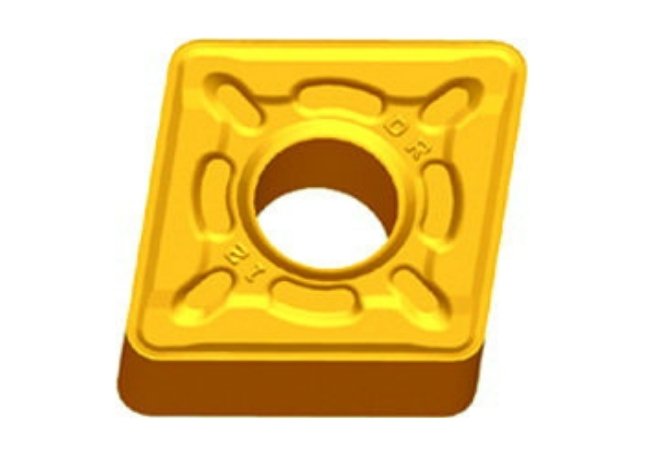
The next insert we have on our list is a diamond insert. It is a popular insert because of its versatility. It can be used on most materials with ease. It has a strong cutting edge and corners of 80 degrees each. As far as its application is concerned, it can be used for both roughing and facing. The opposite angles are 100 degrees which can be helpful for general roughing applications.

However, it can cause chip jamming because of less clearance between the trailing side and the workpiece of the insert.

Next, we have the trigon-shaped insert. It is not very common to use. Trigon is a six cornered, 80-degree diamond-shaped insert that can help increase the economy more as compared with other types of inserts. Its application can be on moderate depths. Meanwhile, it can not go into much depth.

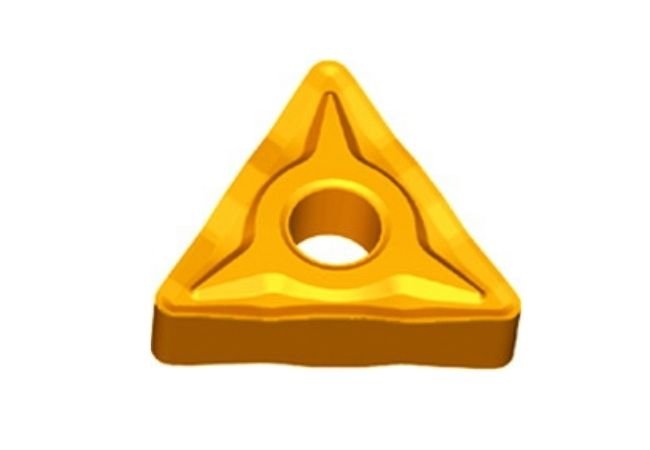
You may have seen triangle carbide insert around you often. This is because it is a versatile shape that can have multiple uses including turning, facing, boring, copy turning, and basic profiling. Adding extra side clearance between the insert and the workpiece bore, these inserts are excellent choices for general boring. But, their edge is comparably weaker than those of 80-degree diamond insert. Furthermore, you must be opting for the right size of the carbide insert not a very large one.

A 55-degree diamond insert is preferred for profiling applications. It can plunge into a small diameter at a specific angle of 30 degrees. It can be used when machining near a tailstock. It may have the drawback of being weaker at the edges than a triangle insert.


A 35-degree diamond carbide insert could be a great choice for copy-turning. Similar to a 55-degree diamond insert it can also work close to the tailstock (closer than a 55-degree insert). However, it can be considered as one of the weakest shaped inserts having depths of cut lighter than others.

It is, therefore, best to use negative style inserts only externally in cavities. However, Positive Style can be used both externally and internally, and the increased cost per edge is often outweighed by the improved performance.

As in any application, grades are vital to the success of the application. As a result, the turning section of any supplier’s catalogue will offer the most grades.

Various turning applications have led to an extensive range of turning grades. These range from continuous cutting, in which no impact is suffered but lots of heat is generated, to interrupted cuts, which have heavy impacts.

From 3-millimetre, Swiss-style machines, to 100-inch, heavy-duty industrial machines, the range of turning grades relates to the wide range of diameters in manufacturing. Depending on the diameter as well as the cutting speed, different grades are suitable for either or both.

Usually, major suppliers provide their range of grades for the different materials. Grades range from tough to hard for interrupted cuts in each series.

For milling applications, there are fewer grades available compared to other applications. The fundamentally interrupted nature of milling tools calls for grades that are hard, impact-resistant, and able to withstand severe conditions. A thin coating is also important for the properties of the coating to withstand impacts, otherwise, it won’t be able to do its job.

It is common for suppliers to use a variety of coatings and tough substrates to mill a large array of metals and other materials.

It is important to note that due to the speed factors involved in cutting, the grade selection during cutting is limited. The diameter, as the cutting direction moves closer to the point, will become smaller. The cutting speed correspondingly decreases as the cutting direction moves closer to the point. Partitioning to the centre results in zero speed at the end of the cut, and instead of cutting, the operation involves shearing.

In other words, a grade for parting off should be able to handle a wide range of cutting speeds, and the substrate should be tough enough to withstand shearing after the operation.

A drilling tool has a cutting speed of zero at the center but varies at the periphery based on its diameter and spindle speed. It is not recommended to use grades designed for high cutting speeds. It is not recommended to use grades designed for high cutting speeds.

Consider the supplier’s catalogue or website for assistance in choosing the correct carbide grade for a given application. It is important to note that there is no formal international standard, but most suppliers use systems that describe grades’ recommended working envelopes by using their three-character “application range” i.e. P05-P20.

Following the ISO standard, the first letter on the list represents the material group. There are letters associated with every material group.

Letter Material
P Steel
M Stainless Steel
K Cast Iron
N Non-Ferrous
S Super-Alloy
H Hardened Steel


Based on a scale of 05 to 45 in increments of 5, these numbers show the relative hardness level of the grade. It is recommended that a hard grade suitable for favorable and stable conditions be used for a 05 application. Considering the conditions that exist in a 45 application, a very tough grade is required to handle potentially adverse ones.

As is the case with these types of values, there is no standard for them, so they should be interpreted as coming from the specific table of grades within the term they are used in. There could be a difference in hardness between grades marked as P10-P20 in two catalogs of two different suppliers.

Grade designations are also not governed by any official standard, just as grade ranges are not governed by an official standard. However, most major carbide insert suppliers follow common grade designation guidelines. Classic designations follow the format BBSSNN, where:


  • BB?Brand Code:?Each of the major suppliers has its letter.
  • SS?Grade Series Number:?A Grade Series Number is usually represented by two random digits that are assigned randomly. Generally, a series is made up of grades created for a single raw material and having the same type of coating.
  • NN?Hardness Level:?It normally indicates the hardness level of the grades within the series of digits that appear at the end of the standard number. In the same way, as the grade charts explained above, the number usually ranges from 05 to 45.

It should be noted that this is true for the most part. It is advisable to keep an eye out for these changes since this is not an ISO/ANSI standard.

Before choosing the correct insert angle, it is vital to consider many parameters first. To achieve good chip control and machining performance, carefully select insert geometry, insert grade, insert shape (nose angle), insert size, nose radius, and enter angle (lead angle).

  • For example, if the operation is finished, you can select the insert geometry according to it.
  • For strength and economy, select the insert with the largest possible nose angle.
  • Based on the depth of cut you expect, select the insert size accordingly.
  • You want the nose radius of the insert to be as large as possible to maximize strength.
  • If vibrations are a frequent occurrence, it may be prudent to select a smaller nose radius.

Essentially, the grade of the insert is determined by several factors such as:

  • Materials for component construction (ISO P, M, K, N, S, H)
  • Method of processing (finishing, medium, roughing)
  • Machine conditions (good, average, hard)Machine conditions (good, average, hard)

There are several advantages to having inserts with optimum geometries and grades. An insert geometry lacking strength can be compensated for by a grade with high toughness.


The type of steel grade to be used as part of an application should be carefully considered before selecting the material. In selecting the right tool, it is critical to consider the application as well as grade, cutting data, and tool wear. To make the right choice, it is also important to consider the existing grade, cutting data, and tool wear.

A hard and wear-resistant grade, such as CH0550, should be the right selection in a continuous H05 application, like turning the face of a gear and its internal diameter. Our testing wasn’t successful. Therefore, we can say that the main thing to consider when choosing a grade is to look at the application as well as to see what the competition is using. In terms of wear resistance versus toughness (ISO application area) chart, CBN060K has been available for a while, but it is still a very good grade in the HPT-chain, and fully capable of beating any competitor in the H15 area. A hard and wear-resistant grade such as CH0550 should be the right choice in continuous applications, such as turning the face and inner diameter of gear, a typical H05 application. But testing did not succeed. So making the right choice depends on your application and the material.


The Carbide Inserts Website: https://www.estoolcarbide.com/product/tnmg-carbide-inserts-for-stainless-steel-turning-inserts-p-1187/

CCMW Insert, ISO 80° Positive Rhombic Indexable Turning Inserts

ESTool CCMT Insert

Description:

ESTool CCMT Insert, 80 Degree, Single-sided CCMT Carbide Turning Inserts with different of molded chipbreaker type. Screw on style insert. Ideal for semi-finishing and finishing on a wide range of materials.

Feature:

  • 80 degree diamond, single sided
  • Positive rake
  • 7° side clearance
  • 6mm, 8mm, 9mm or 12mm cutting edges
  • Available in a range of radius for finishing, general purpose and rough turning
  • Coating: PVD or CVD
  • Material?: Tungsten Carbide


ESTool CCMT Insert
HF
Insert shape ?Type Size (mm)
L ΦI.C S Φd r
HF? Finishing CCMT060202-HF 6.4 6.35 2.38 2.8 0.2
CCMT060204-HF 6.4 6.35 2.38 2.8 0.4
CCMT060208-HF 6.4 6.35 2.38 2.8 0.8
CCMT09T302-HF 9.7 9.525 3.97 4.4 0.2
CCMT09T304-HF 9.7 9.525 3.97 4.4 0.4
CCMT09T308-HF 9.7 9.525 3.97 4.4 0.8
CCMT120404-HF 12.9 12.7 4.76 5.56 0.4
CCMT120408-HF 12.9 12.7 4.76 5.56 0.8
EF
Insert shape ?Type ?Size (mm)
L ΦI.C S Φd r
EF? Finishing CCMT060202-EF 6.4 6.35 2.38 2.8 0.2
CCMT060204-EF 6.4 6.35 2.38 2.8 0.4
CCMT09T302-EF 9.7 9.525 3.97 4.4 0.2
CCMT09T304-EF 9.7 9.525 3.97 4.4 0.4
CCMT09T308-EF 9.7 9.525 3.97 4.4 0.8
CCMT120404-EF 12.9 12.7 4.76 5.56 0.4
CCMT120408-EF 12.9 12.7 4.76 5.56 0.8
HM
Insert shape ?Type ?Size (mm)
L ΦI.C S Φd r
HM? Semi-finishing CCMT060204-HM 6.4 6.35 2.38 2.8 0.4
CCMT060208-HM 6.4 6.35 2.38 2.8 0.8
CCMT09T304-HM 9.7 9.525 3.97 4.4 0.4
CCMT09T308-HM 9.7 9.525 3.97 4.4 0.8
CCMT120404-HM 12.9 12.7 4.76 5.56 0.4
CCMT120408-HM 12.9 12.7 4.76 5.56 0.8
CCMT120412-HM 12.9 12.7 4.76 5.56 1.2
EM
Insert shape ?Type ?Size (mm)
L ΦI.C S Φd r
EM? Semi-finishing CCMT060204-EM 6.4 6.35 2.38 2.8 0.4
CCMT060208-EM 6.4 6.35 2.38 2.8 0.8
CCMT09T304-EM 9.7 9.525 3.97 4.4 0.4
CCMT09T308-EM 9.7 9.525 3.97 4.4 0.8
CCMT120404-EM 12.9 12.7 4.76 5.56 0.4
CCMT120408-EM 12.9 12.7 4.76 5.56 0.8
CCMT120412-EM 12.9 12.7 4.76 5.56 1.2
HR
Insert shape ?Type ?Size (mm)
L ΦI.C S Φd r
HR Roughing CCMT060204-HR 6.4 6.35 2.38 2.8 0.4
CCMT060208-HR 6.4 6.35 2.38 2.8 0.8
CCMT09T304-HR 9.7 9.525 3.97 4.4 0.4
CCMT09T308-HR 9.7 9.525 3.97 4.4 0.8
CCMT120408-HR 12.9 12.7 4.76 5.56 0.8
CCMT120412-HR 12.9 12.7 4.76 5.56 1.2


Hot Sales Products:
Carbide Drilling Inserts
|
CCGT Insert
|
RCGT Insert
|
CNC Inserts
|
Coated Inserts


The Carbide Inserts Website: https://www.estoolcarbide.com/pro_cat/cermet-inserts/index.html

VBGT Insert, Positive Ground 35° Rhombic Carbide Turning Insert

ESTool TNMG Insert

Description:

ESTool TNMG Insert, used for carbon and alloy steel, stainless steel and high temperature alloys.

Feature:

  • 60° Triangular insert
  • Double sided
  • Negative rake
  • Available in a range of radius for finishing, general purpose and rough turning
  • Multi Layer CVD (TiC/Al203/TiN) Aluminum Oxide Coated.? Ideal for machining 200 and 300 series stainless steel, cast irons, non-ferrous alloys and most high temperature alloys.? Excellent wear resistance.
  • Multi Layer CVD (TiN/TiC/TiCN/TiN) coating.? Best for general purpose milling and turning carbon and alloy steels and tool steels.


ESTool TNMG Insert
DF
Insert shape ?Type ?Size (mm)
L ΦI.C S Φd r
?DF? Finishing TNMG160404-DF 16.5 9.525 4.76 3.81 0.4
TNMG160408-DF 16.5 9.525 4.76 3.81 0.8
TNMG160412-DF 16.5 9.525 4.76 3.81 1.2
TNMG220408-DF 22 12.7 4.76 5.16 0.8
TNMG220412-DF 22 12.7 4.76 5.16 0.8
WGF
Insert shape Type ?Size (mm)
L ΦI.C S Φd r
?WGF Finishing wiper TNMX160404-WGF 16.5 9.525 4.76 3.81 0.4
TNMX160408-WGF 16.5 9.525 4.76 3.81 0.8
SF
Insert shape ?Type ?Size (mm)
L ΦI.C S Φd r
?SF Finishing TNMG110304-SF 11 6.35 3.18 2.26 0.4
TNMG160404-SF 16.5 9.525 4.76 3.81 0.4
TNMG160408-SF 16.5 9.525 4.76 3.81 0.8
TNMG220408-SF 22 12.7 4.76 5.16 0.8
TNMG220412-SF 22 12.7 4.76 5.16 1.2
EF
Insert shape Type ?Size (mm)
L ΦI.C S Φd r
EFFinishing TNMG110304-EF 11 6.35 3.18 2.26 0.4
TNMG110308-EF 11 6.35 3.18 2.26 0.8
TNMG160404-EF 16.5 9.525 4.76 3.81 0.4
TNMG160408-EF 16.5 9.525 4.76 3.81 0.8
TNMG160412-EF 16.5 9.525 4.76 3.81 1.2
TNMG220404-EF 22 12.7 4.76 5.16 0.4
TNMG220408-EF 22 12.7 4.76 5.16 0.8
TNMG220412-EF 22 12.7 4.76 5.16 1.2
WGM
Insert shape ?Type Size (mm)
L ΦI.C S Φd r
?WGM Semi-finishing wiper TNMX160408-WGM 16.5 9.525 4.76 3.81 0.8
TNMX160412-WGM 16.5 9.525 4.76 3.81 1.2
PM
Insert shape ?Type ?Size (mm)
L ΦI.C S Φd r
PM Semi-finishing TNMG110304-PM 11 6.35 3.18 2.26 0.4
TNMG110308-PM 11 6.35 3.18 2.26 0.8
TNMG160404-PM 16.5 9.525 4.76 3.81 0.4
TNMG160408-PM 16.5 9.525 4.76 3.81 0.8
TNMG160412-PM 16.5 9.525 4.76 3.81 1.2
TNMG220408-PM 22 12.7 4.76 5.16 0.8
TNMG220412-PM 22 12.7 4.76 5.16 1.2
TNMG220416-PM 22 12.7 4.76 5.16 1.6
DM
Insert shape ?Type ?Size (mm)
L ΦI.C S Φd r
DM Semi-finishing TNMG110308-DM 11 6.35 3.18 2.26 0.8
TNMG160404-DM 16.5 9.525 4.76 3.81 0.4
TNMG160408-DM 16.5 9.525 4.76 3.81 0.8
TNMG160412-DM 16.5 9.525 4.76 3.81 1.2
TNMG220404-DM 22 12.7 4.76 5.16 0.4
TNMG220408-DM 22 12.7 4.76 5.16 0.8
TNMG220412-DM 22 12.7 4.76 5.16 1.2
TNMG220416-DM 22 12.7 4.76 5.16 1.6
EM
Insert shape ?Type ?Size (mm)
L ΦI.C S Φd r
EM Semi-finishing TNMG160404-EM 16.5 9.525 4.76 3.81 0.4
TNMG160408-EM 16.5 9.525 4.76 3.81 0.8
TNMG160412-EM 16.5 9.525 4.76 3.81 1.2
TNMG220408-EM 22 12.7 4.76 5.16 0.8
TNMG220412-EM 22 12.7 4.76 5.16 1.2
TNMG220416-EM 22 12.7 4.76 5.16 1.6
DR
Insert shape ?Type ?Size (mm)
L ΦI.C S Φd r
DR Light load Roughing TNMG160408-DR 16.5 9.525 4.76 3.81 0.8
TNMG160412-DR 16.5 9.525 4.76 3.81 1.2
TNMG220408-DR 22 12.7 4.76 5.16 0.8
TNMG220412-DR 22 12.7 4.76 5.16 1.2
TNMG220416-DR 22 12.7 4.76 5.16 1.6
TNMG270608-DR 27.5 15.875 6.35 6.35 0.8
TNMG270612-DR 27.5 15.875 6.35 6.35 1.2
TNMG270616-DR 27.5 15.875 6.35 6.35 1.6
DR Roughing TNMM160408-DR 16.5 9.525 4.76 3.81 0.8
TNMM160412-DR 16.5 9.525 4.76 3.81 1.2
TNMM220408-DR 22 12.7 4.76 5.16 0.8
TNMM220412-DR 22 12.7 4.76 5.16 1.2
TNMM220416-DR 22 12.7 4.76 5.16 1.6
TNMM270612-DR 27.5 15.875 6.35 5.16 1.2
TNMM270616-DR 27.5 15.875 6.35 5.16 1.6
ER
Insert shape ?Type ?Size (mm)
L ΦI.C S Φd r
ERRoughing TNMG160408-ER 16.5 9.525 4.76 3.81 0.8
TNMG160412-ER 16.5 9.525 4.76 3.81 1.2
TNMG220408-ER 22 12.7 4.76 5.16 0.8
TNMG220412-ER 22 12.7 4.76 5.16 1.2
LR
Insert shape ?Type ?Size (mm)
L ΦI.C S Φd r
LR Light load roughing TNMM160408-LR 16.5 9.525 4.76 3.81 0.8
TNMM160412-LR 16.5 9.525 4.76 3.81 1.2
TNMM220408-LR 22 12.7 4.76 5.16 0.8
TNMM220412-LR 22 12.7 4.76 5.16 1.2
TNMM220416-LR 22 12.7 4.76 5.16 1.6
SNR
Insert shape ?Type ?Size (mm)
L ΦI.C S Φd r
SNR Roughing TNMG160408-SNR 16.5 9.525 4.76 3.81 0.8
HDR
Insert shape ?Type ?Size (mm)
L ΦI.C S Φd r
HDR Gravity cutting TNMM160408-HDR 16.5 9.525 4.76 3.81 0.8
TNMM160412-HDR 16.5 9.525 4.76 3.81 1.2
TNMM220408-HDR 22 12.7 4.76 5.16 0.8
TNMM220412-HDR 22 12.7 4.76 5.16 1.2
TNMM220416-HDR 22 12.7 4.76 5.16 1.6
TNMM270612-HDR 27.5 15.875 6.35 6.35 1.2
TNMM270616-HDR 27.5 15.875 6.35 6.35 1.6
TNMM270624-HDR 27.5 15.875 6.35 6.35 2.4
Insert shape ?Type ?Size (mm)
L ΦI.C S Φd r
Through slot TNMG110308 11 6.35 3.18 2.26 0.8
TNMG160404 16.5 9.525 4.76 3.81 0.4
TNMG160408 16.5 9.525 4.76 3.81 0.8
TNMG160412 16.5 9.525 4.76 3.81 1.2
TNMG220404 22 12.7 4.76 5.16 0.4
TNMG220408 22 12.7 4.76 5.16 0.8
TNMG220412 22 12.7 4.76 5.16 1.2
TNMG220416 22 12.7 4.76 5.16 1.6
TNMG270612 27.5 15.875 6.35 6.35 1.2
TNMG270616 27.5 15.875 6.35 6.35 1.6
TNMG330916 33 19.05 9.525 7.94 1.6
TNMG330924 33 19.05 9.525 7.94 2.4
Through slot TNMM160404 16.5 9.525 4.76 3.81 0.4
TNMM160408 16.5 9.525 4.76 3.81 0.8
TNMM160412 16.5 9.525 4.76 3.81 1.2
TNMM220408 22 12.7 4.76 5.16 0.8
TNMM220412 22 12.7 4.76 5.16 1.2
TNMM220416 22 12.7 4.76 5.16 1.6
TNMM270616 27.5 15.875 6.35 6.35 1.6


Hot Sales Products:
Carbide Milling Inserts
|
RCMX Insert
|
TCMT Insert
|
VBMT Insert
|
Cutting Inserts
|
Lathe Inserts


The Carbide Inserts Website: https://www.estoolcarbide.com/product/new-product-cnc-lathe-tungsten-carbide-inserts-tngg160402-fs-indexableturning-inserts-p-1178/

CNMG Insert, Indexable Carbide CNMG Turning Insert_5

ESTool CNMG Insert

Description:

ESTOOL CNMG Insert designed to cut stainless steel, ?steel, brass, bronze, aluminium and cast iron.

Feature:

  • 80° Rhombic insert
  • Double sided
  • Negative rake
  • Good edge strength
  • High wear resistance
  • High toughness
  • Long service life
  • High processing stability
  • Coating: PVD or CVD
  • Available in a range of radius for finishing, general purpose and rough turning


ESTool CNMG Insert
DF
Insert shape ?Type ?Size (mm)
L ΦI.C S Φd r
DFFine finishing CNMG090304-DF 9.7 9.525 3.18 3.81 0.4
CNMG090308-DF 9.7 9.525 3.18 3.81 0.8
CNMG120404-DF 12.9 12.7 4.76 5.16 0.4
CNMG120408-DF 12.9 12.7 4.76 5.16 0.8
CNMG120412-DF 12.9 12.7 4.76 5.16 1.2
WGF
Insert shape Type ?Size (mm)
L ΦI.C S Φd r
WGF Fine finishing Wiper CNMG120404-WGF 12.9 12.7 4.76 5.16 0.4
CNMG120408-WGF 12.9 12.7 4.76 5.16 0.8
SF
Insert shape ?Type ?Size (mm)
L ΦI.C S Φd r
SFFine Finishing CNMG090304-SF 9.7 9.525 3.18 3.81 0.4
CNMG090308-SF 9.7 9.525 3.18 3.81 0.8
CNMG120404-SF 12.9 12.7 4.76 5.16 0.4
CNMG120408-SF 12.9 12.7 4.76 5.16 0.8
CNMG120412-SF 12.9 12.7 4.76 5.16 1.2
EF
Insert shape ?Type ?Size (mm)
L ΦI.C S Φd r
EFFine Finishing CNMG090304-EF 9.7 9.525 3.18 3.81 0.4
CNMG090308-EF 9.7 9.525 3.18 3.81 0.8
CNMG120404-EF 12.9 12.7 4.76 5.16 0.4
CNMG120408-EF 12.9 12.7 4.76 5.16 0.8
CNMG120412-EF 12.9 12.7 4.76 5.16 1.2
NF
Insert shape ?Type ?Size (mm)
L ΦI.C S Φd r
NFFine Finishing CNEG120404-NF 12.9 12.7 4.76 5.16 0.4
CNEG120408-NF 12.9 12.7 4.76 5.16 0.8
CNEG120412-NF 12.9 12.7 4.76 5.16 1.2
WGM
Insert shape Type ?Size (mm)
L ΦI.C S Φd r
WGMSemi-finished polishing blade CNMG120408-WGM 12.9 12.7 4.76 5.16 0.8
CNMG120412-WGM 12.9 12.7 4.76 5.16 1.2
PM
Insert shape ?Type ?Size (mm)
L ΦI.C S Φd r
PMSemi-finished CNMG090304-PM 9.7 9.525 3.18 3.81 0.4
CNMG090308-PM 9.7 9.525 3.18 3.81 0.8
CNMG120404-PM 12.9 12.7 4.76 5.16 0.4
CNMG120408-PM 12.9 12.7 4.76 5.16 0.8
CNMG120412-PM 12.9 12.7 4.76 5.16 1.2
CNMG120416-PM 12.9 12.7 4.76 5.16 1.6
CNMG160608-PM 16.1 15.875 6.35 6.35 0.8
CNMG160612-PM 16.1 15.875 6.35 6.35 1.2
CNMG160616-PM 16.1 15.875 6.35 6.35 1.6
CNMG190608-PM 19.3 19.05 6.35 7.94 0.8
CNMG190612-PM 19.3 19.05 6.35 7.94 1.2
CNMG190616-PM 19.3 19.05 6.35 7.94 1.6
DM
Insert shape ?Type ?Size (mm)
L ΦI.C S Φd r
DMSemi-finished CNMG090304-DM 9.7 9.525 3.18 3.81 0.4
CNMG090308-DM 9.7 9.525 3.18 3.81 0.8
CNMG120404-DM 12.9 12.7 4.76 5.16 0.4
CNMG120408-DM 12.9 12.7 4.76 5.16 0.8
CNMG120412-DM 12.9 12.7 4.76 5.16 1.2
CNMG120416-DM 12.9 12.7 4.76 5.16 1.6
CNMG160608-DM 16.1 15.875 6.35 6.35 0.8
CNMG160612-DM 16.1 15.875 6.35 6.35 1.2
CNMG160616-DM 16.1 15.875 6.35 6.35 1.6
CNMG190608-DM 19.3 19.05 6.35 7.94 0.8
CNMG190612-DM 19.3 19.05 6.35 7.94 1.2
CNMG190616-DM 19.3 19.05 6.35 7.94 1.6
EM
Insert shape ?Type ?Size (mm)
L ΦI.C S Φd r
EM Semi-finished CNMG120404-EM 12.9 12.7 4.76 5.16 0.4
CNMG120408-EM 12.9 12.7 4.76 5.16 0.8
CNMG120412-EM 12.9 12.7 4.76 5.16 1.2
CNMG160608-EM 16.1 15.875 6.35 6.35 0.8
CNMG160612-EM 16.1 15.875 6.35 6.35 1.2
CNMG160616-EM 16.1 15.875 6.35 6.35 1.6
NM
Insert shape ?Type Size (mm)
L ΦI.C S Φd r
NM Semi-finished CNMG120404-NM 12.9 12.7 4.76 5.16 0.4
CNMG120408-NM 12.9 12.7 4.76 5.16 0.8
CNMG120412-NM 12.9 12.7 4.76 5.16 1.2
DR
Insert shape ?Type ?Size (mm)
L ΦI.C S Φd r
DR Light load roughing CNMG120408-DR 12.9 12.7 4.76 5.16 0.8
CNMG120412-DR 12.9 12.7 4.76 5.16 1.2
CNMG120416-DR 12.9 12.7 4.76 5.16 1.6
CNMG160608-DR 16.1 15.875 6.35 6.35 0.8
CNMG160612-DR 16.1 15.875 6.35 6.35 1.2
CNMG160616-DR 16.1 15.875 6.35 6.35 1.6
CNMG190608-DR 19.3 15.875 6.35 7.94 0.8
CNMG190612-DR 19.3 19.05 6.35 7.94 1.2
CNMG190616-DR 19.3 19.05 6.35 7.94 1.6
CNMG190624-DR 19.3 19.05 6.35 7.94 2.4
ER
Insert shape ?Type Size (mm)
L ΦI.C S Φd r
ER? Roughing CNMG120408-ER 12.9 12.7 4.76 5.16 0.8
CNMG120412-ER 12.9 12.7 4.76 5.16 1.2
CNMG160612-ER 16.1 15.875 6.35 6.35 1.2
CNMG160616-ER 16.1 15.875 6.35 6.35 1.6
CNMG190612-ER 19.3 19.05 6.35 7.94 1.2
CNMG190616-ER 19.3 19.05 6.35 7.94 1.6
SNR
Insert shape ?Type ?Size (mm)
L ΦI.C S Φd r
SNR? Roughing CNMG120408-SNR 12.9 12.7 4.76 5.16 0.8
CNMG120412-SNR 12.9 12.7 4.76 5.16 1.2
CNMG160608-SNR 16.1 15.875 6.35 6.35 0.8
CNMG190616-SNR 19.3 19.05 6.35 7.94 1.6
Insert shape ?Type ?Size (mm)
L ΦI.C S Φd r
Through Slot CNMG120404 12.9 12.7 4.76 5.16 0.4
CNMG120408 12.9 12.7 4.76 5.16 0.8
CNMG120412 12.9 12.7 4.76 5.16 1.2
CNMG160608 16.1 15.875 6.35 6.35 0.8
CNMG160612 16.1 15.875 6.35 6.35 1.2
CNMG160616 16.1 15.875 6.35 6.35 1.6
CNMG190608 19.3 19.05 6.35 7.94 0.8
CNMG190612 19.3 19.05 6.35 7.94 1.2
CNMG190616 19.3 19.05 6.35 7.94 1.6


Hot Sales Products:
Carbide Milling Inserts
|
Surface Milling Inserts
|
Tungsten Steel Inserts
|
WCMT Insert
|
VBMT Insert
|
Indexable Inserts


The Carbide Inserts Website: https://www.estoolcarbide.com/pro_cat/turning-inserts/index.html