CNMG Insert, Indexable Carbide CNMG Turning Insert_13

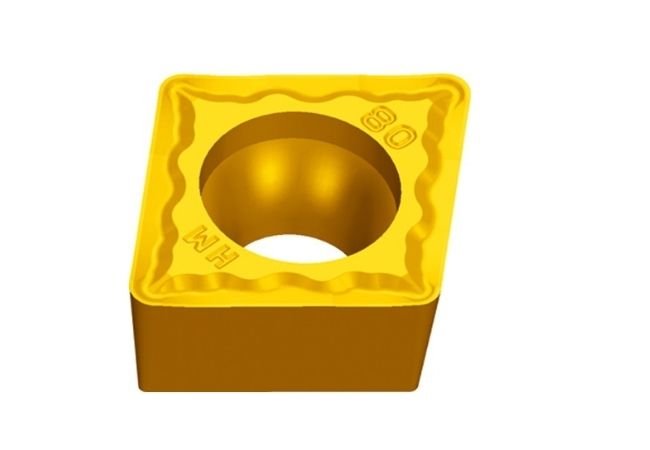
ESTool CCMT Insert

Description:

ESTool CCMT Insert, 80 Degree, Single-sided CCMT Carbide Turning Inserts with different of molded chipbreaker type. Screw on style insert. Ideal for semi-finishing and finishing on a wide range of materials.

Feature:

  • 80 degree diamond, single sided
  • Positive rake
  • 7° side clearance
  • 6mm, 8mm, 9mm or 12mm cutting edges
  • Available in a range of radius for finishing, general purpose and rough turning
  • Coating: PVD or CVD
  • Material?: Tungsten Carbide


ESTool CCMT Insert
HF
Insert shape ?Type Size (mm)
L ΦI.C S Φd r
HF? Finishing CCMT060202-HF 6.4 6.35 2.38 2.8 0.2
CCMT060204-HF 6.4 6.35 2.38 2.8 0.4
CCMT060208-HF 6.4 6.35 2.38 2.8 0.8
CCMT09T302-HF 9.7 9.525 3.97 4.4 0.2
CCMT09T304-HF 9.7 9.525 3.97 4.4 0.4
CCMT09T308-HF 9.7 9.525 3.97 4.4 0.8
CCMT120404-HF 12.9 12.7 4.76 5.56 0.4
CCMT120408-HF 12.9 12.7 4.76 5.56 0.8
EF
Insert shape ?Type ?Size (mm)
L ΦI.C S Φd r
EF? Finishing CCMT060202-EF 6.4 6.35 2.38 2.8 0.2
CCMT060204-EF 6.4 6.35 2.38 2.8 0.4
CCMT09T302-EF 9.7 9.525 3.97 4.4 0.2
CCMT09T304-EF 9.7 9.525 3.97 4.4 0.4
CCMT09T308-EF 9.7 9.525 3.97 4.4 0.8
CCMT120404-EF 12.9 12.7 4.76 5.56 0.4
CCMT120408-EF 12.9 12.7 4.76 5.56 0.8
HM
Insert shape ?Type ?Size (mm)
L ΦI.C S Φd r
HM? Semi-finishing CCMT060204-HM 6.4 6.35 2.38 2.8 0.4
CCMT060208-HM 6.4 6.35 2.38 2.8 0.8
CCMT09T304-HM 9.7 9.525 3.97 4.4 0.4
CCMT09T308-HM 9.7 9.525 3.97 4.4 0.8
CCMT120404-HM 12.9 12.7 4.76 5.56 0.4
CCMT120408-HM 12.9 12.7 4.76 5.56 0.8
CCMT120412-HM 12.9 12.7 4.76 5.56 1.2
EM
Insert shape ?Type ?Size (mm)
L ΦI.C S Φd r
EM? Semi-finishing CCMT060204-EM 6.4 6.35 2.38 2.8 0.4
CCMT060208-EM 6.4 6.35 2.38 2.8 0.8
CCMT09T304-EM 9.7 9.525 3.97 4.4 0.4
CCMT09T308-EM 9.7 9.525 3.97 4.4 0.8
CCMT120404-EM 12.9 12.7 4.76 5.56 0.4
CCMT120408-EM 12.9 12.7 4.76 5.56 0.8
CCMT120412-EM 12.9 12.7 4.76 5.56 1.2
HR
Insert shape ?Type ?Size (mm)
L ΦI.C S Φd r
HR Roughing CCMT060204-HR 6.4 6.35 2.38 2.8 0.4
CCMT060208-HR 6.4 6.35 2.38 2.8 0.8
CCMT09T304-HR 9.7 9.525 3.97 4.4 0.4
CCMT09T308-HR 9.7 9.525 3.97 4.4 0.8
CCMT120408-HR 12.9 12.7 4.76 5.56 0.8
CCMT120412-HR 12.9 12.7 4.76 5.56 1.2


Hot Sales Products:
tungsten carbide inserts
|
tungsten carbide inserts
|
CCMT Insert
|
VNMG Insert
|
TNMG Insert


The Carbide Inserts Website: https://www.estoolcarbide.com/machining-inserts/tcmt-insert/

Is Automation a Job Killer?


Posted on: Nov 13, 2023, | By Tony, Estoolcarbide Project Manager

There are headlights, taillights, fog lamps and so on. All kinds of lights have different uses. Did you do any research on the effects of headlights if you are automotive lighting manufacturers ? Do you understand the prototype manufacturing process of the car lamp design stage? Estoolcarbide Rapid?prototype manufacturing will answer for you.

Car headlights, also known as car headlamps, as the eyes of a car, not only related to the external image of a Cast Iron Inserts car owner but also close to the safe driving during night driving or bad weather conditions. The material of the headlight needs to ensure that the vehicle has a bright and steady illumination while driving at night so that the driver can clearly distinguish objects within 100 meters. At the same time, there must be an anti-glare device, to ensure the safety of driving at night.

Materials and performance requirements:

Part Name Production material Prototype material Property requirement
Lens PC PMMA、 PC Scratch resistant, transparent, UV stable
Bezel PC、PCHT、PBT、PBT/PET PMMA 、ABS Heat resistant, metalized, high surface quality
Lightguide PC PMMA 、PC Transparent, UV stable
Reflector PC、PBT、PPS、BMC ABS 、Aluminium High heat resistant, high rigidity, metalized, high impact resistant
Housing PP+T40、PP+T20 ABS Dimensional stability, heat resistant

The taillight is a signal light that transfers brake, steering and other important information. Due to its high frequency of use in the city, the performance requirements of the material are also high. The material must have high heat resistance, good processability, wettability and bright colors.

Materials and performance requirements:

Part Production material Prototype material Property requirement
Outer Lens PMMA PMMA PC Scratch resistant, transparent, UV stable
Housing ABS、PC/ABS、ASA ABS Dimensional stability, heat resistant
Inner Lens PC、PCHT PMMA PC Transparent, UV stable
Frame ABS ABS Dimensional stability
Lightguide PC PMMA PC Transparent, UV stable

In the case of low visibility, such as rain and fog weather, the role of large headlights is limited. So the fog lamp needs to pass through the fog and other obstacles to ensure the normal line of sight. Because of the high power and temperatures of the fog lamps, the materials needed also should have high heat resistance.

Materials and performance requirements:

Part Production material Prototype material Property requirement
Lens PC + hard coating、PMMA PMMA PC Scratch resistant, transparent, UV stable
Housing PCHT、PEI、PBT/ASA、LCP、PC/ABS ABS Dimensional stability, heat resistant
Reflector PCHT、PEI、PC ABS High heat resistant, high rigidity, metalized, high impact resistant

Currently, the main technology used in the field of automotive lighting prototype includes 3D printing, CNC machining, silicone mold and rapid aluminum mold, which have their own advantages. The following are the different technical applications of the different stages of development based on Estoolcarbide’s years of experience in providing rapid prototyping services and automotive prototyping for the design and development of automotive lamps:

CNC headlamp prototype machining is characterized as high precision, fast response and short cycle (1-2 weeks of delivery), which makes it possible to machine complex shapes in one piece of material. Usually, in concept stage (conceptual stage) and engineering stage (engineering design stage), it is necessary to make an appearance or function model for a part of the headlight, such as a light pipe or a reflector cup. This demand often requires the ability to produce high-precision prototypes in the shortest cycles with real materials, and CNC is the best choice.

Due to the complicated structure of the lamp, there are many optical details and undercuts, and even high-precision 5-axis CNC can’t process the whole part all at once. CNC programming engineers, who have rich experience in prototype lamp manufacturing, need to analyze the feasibility of machining after obtaining the drawings of the lamp design. For those parts that can’t be processed integrally, they need to provide the solution for disassembly processing, especially for critical surfaces.

In the later stage of prototype production, deburring, polishing, bonding and painting, and other handmade post-processing work is particularly important, will directly determine the final appearance.

There?is?no?draft?consideration?for?silicone?mold as it is one of the simplest ways in the rapid tools, with good flexibility and replication performance. Therefore, this technology is widely used in the low volume production of car lamps.

For low volume headlamp parts using silicon mold, it is particularly important to choose the manufacturing methods and materials in order to meet the appearance and performance requirements of different parts.

For LENS and BEZEL, which require mirror polishing, we usually choose CNC to make a prototype of PMMA with the high-quality surface finish. The silicone mold made by such method can ensure the perfect appearance of the casting.

For structural parts with fewer appearance requirements, such as housing, we use RP technology such as SLA to make the prototype and choose AXSON PX223 with excellent temperature resistance as the casting material.

Following is a typical project for reference:

Rapid mold materials are mainly soft steel (for example, P-20) and aluminum (such as 7075 T-6 Aerospace grade aluminum). Compared to hard steel, it can increase the processing speed by 15% to 30%, and the polishing time can be 3 to10 times faster with lighter weight, so as to reduce the cost of making the mold and shortens the cycle. In addition, the rapid aluminum tool facilitates temperature control, allowing faster cycle times and eliminating plastic stress.

As the car is in the development stage, it is necessary to evaluate its processing cycle as well as the manufacturing cost, and these can be obtained through rapid aluminum tooling. For example, engineers can produce small batch lamps through a rapid aluminum tool for loading tests or upfront market launches. The biggest advantage of rapid aluminum tooling is that it has the real material and real structure. Not only the reaction cycle is fast, but also the production cycle and cost can be evaluated reasonably and truly. Below is the project cycle of Estoolcarbide’s rapid taillight production of aluminum parts:

Compared with ordinary steel mold, the two materials made almost the same surface quality. The life of Tungsten Steel Inserts aluminum mold is related to the complexity of the product, although far lower than the steel mold, but also can achieve no less than 1000 times of service life, which is more than enough for the initial loading test.

Following is an aluminum tool table on the taillights parts:

The Carbide Inserts Website: https://www.estoolcarbide.com/product/use-for-surface-milling-and-shoulder-milling-cutters-blmp0603r-blmp0904r-excellent-performance-indexable-milling-inserts/

Producing Precision Gears

Assuming you’ve already taken the necessary precautions that will allow you to safely handle parts additively built from metallic powder and feedstock, your next question likely is: What is the best method for removing their metal support structures? For parts manufactured in laser-based powder-bed systems, those support structures will be of the same material as the part itself, whether that is a titanium alloy such as Ti-6Al-4V (Ti64) or a nickel chromium alloy like Inconel 718.

Logic might dictate that you use the same feeds and speeds to machine away the support structures as you would to machine any other part made from these materials, but the jury is still out on this case for two important reasons:

1) In subtractive machining, you start with a material that has the properties you want and then create the shape you want from it. In additive manufacturing, it is the reverse: You build the shape you want and then heat treat, age and solution-anneal the material to get the properties you want. So depending on the postprocessing heat treatment (or lack thereof), the microstructure of an additive part will vary, which means you may not be post-machining the grade of material you think you are. In short, you will not know exactly what material you are machining when you are removing metal support structures from an AM part.

2) Support structures are often hollow, which means you are not continuously machining metal as you cut through them. The images in Figure 1 show what you will likely encounter: a thin-walled, mostly solid support, then air, then another thin wall, then air, and so on. Furthermore, most supports are not fully dense, particularly in the build direction. Since the supports will be removed from the finished part, it seems unnecessary to make them fully dense, so laser-path planning algorithms often skip every other layer of the supports, saving material and reducing build time. Figure 2 shows the hatch spacing (laser-scan path) for a part and its supports. The tightly spaced gray lines represent the laser path for the part, while the sparser pink lines indicate the laser path for the supports. The tighter hatch spacing yields a fully dense part, while the coarser spacing will lead to slightly porous supports.

Figure 1 also illustrates the challenges in removing internal support structures by different machining methods. These images were taken by a capstone engineering design team at Pennsylvania State University that was tasked with finding ways to remove the supports from a stainless steel piston crown. As you can see by the top left image, a standard drill was Cutting Inserts fairly ineffective, crushing the supports inward instead of removing them. The end mill (top right) and ball-end grinding stone (bottom right) were only slightly more effective, still tending to crush/tear the supports away versus cleanly removing them. As shown in the bottom left image, it was the cylinder burr that seems to have done the best job on this material and support-structure geometry, removing the supports cleanly as it plunged into the stainless steel thin-walled structures. Had the part been heat treated or made from a different material, or had a different support geometry been used, the results likely would not have been the same, and a different tool/approach would likely have faired better. 

In summary, machining away metallic supports remains a challenge for additive manufacturing. While most SNMG Insert researchers have focused on gaining a better understanding of the additive manufacturing process itself, few have spent the necessary time and energy to understand what it takes to remove support structures and finish additively manufactured parts efficiently and effectively. In many cases, service bureaus offering AM capabilities do not have postprocessing and finishing capabilities in house or may not be asked (or inclined) to remove support structures from a part. For those of you that have both additive and subtractive capabilities, or an interest in contributing to the postprocessing of additively manufactured parts, we desperately need your help.

The Carbide Inserts Website: https://www.estoolcarbide.com/product/tngg160402r-l-s-grinding-cermet-inserts-p-1212/

A Post about Sheet Metal Processing Methods with Details

Contents hide 1The calculation principle of expansion is as follows 2Calculation method: 2.1basic formula of expansion: 2.2design value of dimension with tolerance: 3Pre opening bottom hole 4Open process hole 5what do we do about hole around a bending edge 6Smooth surface and burr surface 7Requirements for unfolding in folding machine processingThe calculation principle of expansion is as follows

In the process of bending, there is tension stress in the outer layer and compression stress in the inner layer. From tension to compression, there is a transition layer neutral layer. The length of neutral layer remains the same after bending as before bending, so the neutral layer is the basis for calculating the unfolding length of bending parts. The position of neutral layer is related to the degree of deformation. When the bending radius (R angle shown in the figure below) is larger and the bending angle (θ angle shown in the figure below) increases, the degree of deformation increases, the position of neutral layer gradually moves to the inner side of the bending center, and the distance between neutral layer and inner layer of sheet metal is less than 90

Calculation method:basic formula of expansion:

Expansion length=in stock + in stock + compensation

Development length=out of stock + out of stock – compensation

Right angle bending:

(R ≤ 2.0 θ=90). L=a + B-K (see Table 2 for K value)

(R>2? ?θ=90)L=a+b+K

K=(R+λ)*π/2  

Note: when R ≥ 5T, λ=0.5T

When R < 5T, λ=0.4t

a. B is a direct boundary value tangent to R

Obtuse angle bending:

( R≤2.0? ?θ>90):

L=a + B + (θ / 90) * k (see Table 1 for K value)

(R>2? θ>90 ):L=A+B+K?

 K=(R+λ)*πθ/180

Note:

When R ≥ 5T, λ=0.5T

When R < 5T, λ=0.4t

A. B is a straight boundary value tangent to R

Acute bend:

2(R≠0   θ<90):

L=A+B+K  K=(R+λ)* πθ/180

Note:

When R ≥ 5T, λ=0.5T

When R < 5T, λ=0.4t

A. B is a straight boundary value tangent to R

Z-fold (straight edge difference)

1. When h ≥ 4T, it is formed in two times and calculated according to two 90 bends.

2. When h < 4T, one-time molding.

L=a + B + K (see Table 3 for K value)

Z-fold (bevel segment difference)

1. When h < 2T, it is calculated in the way of straight edge segment difference, i.e. L=D + K (see Table 3 for K value)

When h ≥ 2T, unfold by two-stage bending (θ≠ 90)

Folding and flattening

1.L=A+B-0.4T

N fold

1. When the n-fold processing method is to fold and flatten the gasket, press

L=a + B + K. (see Table 4 for K value).

When n-fold is processed in other ways, it is calculated according to the general bending (R ≠ 0 θ≠ 90) “

design value of dimension with tolerance:

take the middle value of upper and lower limit dimension as design standard value

Pre opening bottom hole

In the process of unfolding, in addition to the shape unfolding, we need to take out teeth (flanging) tapping, tapping (extruding and cutting) flanging expanding riveting nuts (class Z products), flower tooth pressing riveting nuts (class s products), pressing riveting screws (class FH products) and pressing riveting screws (class NY products) Rivet nut column (so, BSO, soo, SOPC products) (pay attention to the difference between 3.5m3 and M3 bottom hole). In the process of unfolding, the bottom hole should be pre opened (see Table 5 for details)

Open process hole

For some products with low precision and need to be welded and polished, we can open a bending process hole at the bending corner. The size is determined by the plate thickness. It should be larger than the plate thickness, and it should not be too large. In the programming process, we should try to select the appropriate mold that has been used. (easy to reduce mold and processing time).

No process hole is needed for all the edge lapping relationships;

There are three kinds of graphs: all inclusive, half inclusive and edge overlapping.

For the thickness t < 1.5mm, there is no need to open the process hole;

If the plate thickness t ≥ 1.5mm with edge wrapping, the process hole shall be added at the corner.

There are two kinds of process holes: round and U-shaped; the center of the long round hole is on the bending line.

As shown in figure A.B

The expanded part is the part of line segment, TCGT Insert which is processed into the form of process hole as shown in the figure below: as shown in Figure C

The width of process hole is 0.5 (laser) or 2.0 (NCT).

when the distance between the Extraction edge and the bending edge (inner dimension) is less than 2.0 mm, the bending process will be affected. At this time, the corresponding bending deformation area will be cut or the extraction dimension will be changed, as shown in Figure E

Under the following circumstances, it is not allowed to open process holes:

Parts with appearance or assembly relationship requirements and without customer’s permission;

Separate shipment, without the customer’s permission.

Japanese customers didn’t ask to start yikong:

2) In the following cases, the programmer can open the process hole at his own Machining Inserts discretion:

the workpiece that needs to be welded and filled up in the next process after opening the angle of the process hole;

the workpiece that is not the appearance surface and does not affect the assembly and function, and is assembled inside the whole machine for shipment.

In the following cases, the Engineer shall negotiate with the customer to open the process hole

Work pieces that affect bending or die forming but have no process holes on the drawing.

All the parts without fillet (laser) after product development shall be rounded according to r0.5.

what do we do about hole around a bending edge

It is worth noting that when we find that there is a hole close to the bending edge in the process of unfolding, and the hole will bend after bending, we need to inform the engineer whether to open the bottom hole first and then expand the hole after bending. ?

There are two general formulas for reference

LMIN=(2.0-2.5)T+D/2 

L1 < V / 2 (V is V groove of lower die)

Smooth surface and burr surface

in the process of unfolding, smooth surface and burr surface are one of the important contents that we must consider. Generally, for those not specified in the drawing and not specially required by customers, such as folding a box, we usually regard the inside as burr surface and the outside as smooth surface. For customers (such as Japanese customers such as VGI, TBS, Seiko, etc.), there are special requirements, which are clearly indicated in the drawings. We will carry out according to the requirements of the drawings.

Requirements for unfolding in folding machine processing

The general form of bending process of folding machine is shown in the attached figure. The selection of V groove is related to the material thickness, and its minimum hem size is limited by V groove. Its relationship is shown in the attached table

Note: the minimum bending L in the table must be upper die with sharp knife;

The minimum h is Z-fold secondary molding (H ≥ 5T).

For Z-fold one-time forming (H ≤ 5T), the maximum length of Z-fold one-time forming is 835mm (2pcs), and there is no blocking in the middle.

The thickness of fault plate T: 0.5-2.3, the height of fault plate H: 0.5-10 mm.

Material saving placement: after the unfolding inspection is OK, we have to choose a reasonable placement method (generally x value > y value) to see how to place the most economical material, and rotate the unfolding drawing to a reasonable position (do not mirror, the burr surface will be reversed) And then arrange the knives.

Our Website: https://www.estoolcarbide.com/product/cemented-carbide-inserts-pvd-coating-snmg120404-ha-use-for-planer-tool/

The Elixir of Machining Threads–Whirlwind Milling

In the lathe for non turning processing, is the lack of equipment and other factors have to do it, but in this process, the intelligent working people found that after the transformation of the machine tool, can complete a lot of efficient and high-quality processing.

In the milling process on the lathe, there is a kind of whirlwind milling thread, which is one of them.

Contents hide 1What is whirlwind milling 2Necessary equipment for whirlywind milling 3Whirlwind milling process 4Advantages of whirlwind millingWhat is whirlwind milling

Because of its high milling speed (up to 400m / min) and high machining efficiency, compressed air is used for chip removal and cooling. In the process of machining, cutting spatter is named after whirlwind.

Whirlwind milling thread is a method that whirlwind milling head is used to process thread, which only needs one cutting.

1.Determination process of whirlwind milling tool

2.Determine part shape

3.Determine tool shape according to parts

4.Make the corresponding blade

There are several companies specialized in the production of thread milling inserts, such as Camex, NTK, haoen and Fengyi, which are commonly used in domestic cyclone milling equipment.

5.Install the blade on the cutter?head

  • Five movements of whirlwind milling
  • After the whirlwind milling is matched with the lathe, five machining movements need to be completed in the processing process
  • The cutter head drives the carbide forming cutter to rotate at high speed (main motion)
  • Qualification
  • Express alarm about
  • The lathe spindle drives the workpiece to rotate slowly (auxiliary motion)
  • The whirlwind milling machine moves along the axial direction of the workpiece according to the pitch or lead of the workpiece (feed motion)
  • The whirlwind milling is driven by the carriage in the lathe to carry out radial movement (cutting movement)
  • The spiral milling angle can be adjusted within a certain range. (rotational motion)

Necessary equipment for whirlywind milling

Equipment structure of whirlwind mill:

  • Medical industry (implants).
  • Medical industry, medical bone nail, etc

    • Automotive industry.

    Automobile automatic transmission shaft, such as transmission shaft on automatic seat, etc

    • Machine tool industry and others.

    Machine tool screw with whirlwind milling processing, will have a high efficiency

    Whirlwind milling process

    1. It is composed Cemented Carbide Inserts of whirlwind milling cutter head, workpiece and guide sleeve.

    2. Adjust the installation deflection angle according to the screw angle of the thread.

    The installation deflection angle determines the size of thread pitch, and large installation angle determines the processing of large pitch thread.

    3. Down milling

    The rotation direction of the whirlwind milling cutter head is opposite to that of the machine tool spindle (part), so it can process good surface quality. On the contrary, it is reverse milling, and the surface quality is poor.

    Advantages of whirlwind milling

    Advantages of whirlwind milling APMT Insert thread cutting:

    1. High processing efficiency, higher than the traditional turning processing efficiency! Up to 10 times.

    2. The product is formed by one knife, and the eccentric cutting does not need to withdraw the cutter.

    3. Without changing the structure of lathe, the angle of helix can be adjusted, and the installation is convenient.

    4. The surface roughness can reach Ra0.8 μ m or even higher, and the machining accuracy can be improved by 2 levels.

    5. The programming method is simple and fast, forming blade, high positioning accuracy of blade and blade groove, reducing the technical requirements of workers.

    Whirlywind milling can achieve dry cutting, heavy cutting, difficult to machine materials and ultra-high speed cutting, with low power consumption. The surface roughness can reach Ra0.8 μ M. Lathe spindle speed is slow, so the machine tool motion accuracy is high, dynamic stability is good, is an advanced thread processing method.

    Our Website: https://www.estoolcarbide.com/product/tcgt-aluminum-inserts-p-1221/

    WHAT MAKES TUNGSTEN CARBIDE POPULAR IN POWER TOOL ACCESSORIES

    There’s a perception that accessories using tungsten carbide perform better than non-carbide ones. But does that perception match reality?

    In most cases, it does. Carbide blades outperform and last longer than steel or bi-metal in nearly every application. That combination makes it the go-to standard for the best miter saw blades and rotary hammer bits. It’s also gaining more traction for reciprocating saw blades and oscillating tool blades, too.

    In terms of raw speed, some tasks benefit from standardized blades. In particular, steel reciprocating blades may cut more quickly in certain materials. Since they can optimize the teeth geometry to the material and avoid the wider kerf sizes, steel blades often beat wider, slower carbide-toothed blades. You also can’t beat the CCGT Insert price of a cheap steel reciprocating saw blade. If you don’t intend to cut anything but wood or PVC, a steel blade works great.

    Related search keywords:
    Carbide blade, Carbide Saw Blade, carbide saw tips, carbide saw blade sharpening machine, carbide saw blades for steel, carbide saw blade to cut aluminum, carbide saw blade for weed eater, carbide saw blade for aluminum, carbide saw blade bunnings, best carbide saw blade, carbide saw blade cutter, carbide saw blade for metal, carbide circular saw blade for metal cutting, carbide saw blade, carbide blade, carbide saw tips, carbide saw blade tips, tungsten carbide saw blade tips, saw blade carbide welding, zhuzhou estoolcarbide tools co. ltd, tungsten carbide blade, carbide wear parts, carbide rods, carbide tip, saw blade for metal, carbide sleeve, carbide plate, carbide rod, carbide tool, carbide cutting tools, tungsten carbide inserts carbide parts, saw blade for wood, carbide strips, bunnings carbide circular saw blade, carbide burs

    The Carbide Inserts Blog: https://www.estoolcarbide.com/cutting-inserts/